Welcome to Reed’s Home Solutions

RESIDENTIAL SERVICES · LEXINGTON, KY

Crawl Space Encapsulation in Lexington, KY

Crawl Space Encapsulation Contractors in Lexington, KY

Crawl space encapsulation seals the area under your house from the soil below and the outside air around it, then controls the humidity inside. In Lexington, KY, where summers are sticky and spring rain keeps the ground wet for weeks, that combination is what finally ends the musty smell, the damp insulation and the cold, soft floors above.

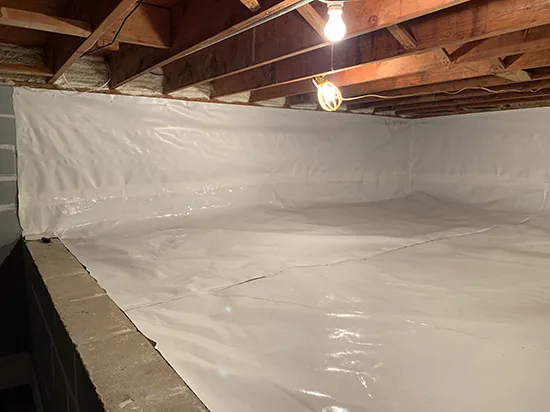
Reed’s Home Solutions installs crawl space encapsulation in Lexington and across Central Kentucky. A full system is not just a plastic sheet on the dirt. It is a heavy polyethylene barrier on the floor and walls, sealed seams, closed vents, a tight access door, drainage where the space needs it, insulation and a dehumidifier working together as one system.

Every job starts with a free, no-obligation inspection and a written scope and price.

Crawl Space Encapsulation Liner in Lexington, KY

What Is Included in Crawl Space Encapsulation

A complete encapsulation has four jobs. Each one covers a different way moisture gets in or stays in.

A 30-Mil Barrier on Floor and Walls

A thick, puncture-resistant polyethylene barrier covers the ground and runs up the foundation walls. Seams are overlapped and sealed so soil moisture has nowhere to go.

Vents Closed, Door Sealed

Crawl space vents are closed and air-sealed, and the access door is made tight. Humid Kentucky air stops flowing through the space, and pests lose an easy way in.

Drainage Where It Is Needed

If water collects or seeps in, we add drainage and, when called for, a crawl space sump pump so the barrier is not working against standing water.

Insulation and a Dehumidifier

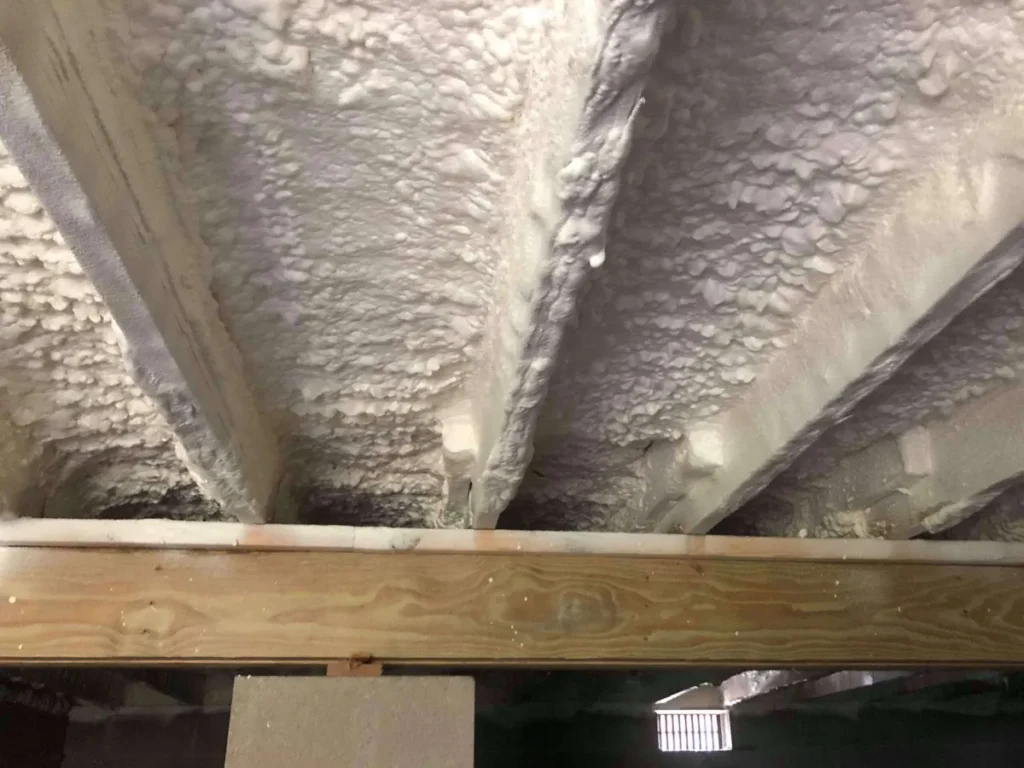
Wall insulation keeps the sealed space comfortable, and a crawl space dehumidifier holds the humidity below 60%. See our crawl space insulation options.

Signs Your Lexington Crawl Space Needs Encapsulation

The clues usually show up upstairs first.

Together these usually point to humid vented air, ground moisture or a vapor barrier that is thin, torn or missing. A wet crawl space does not stay in the crawl space, so the fix belongs there too.

Why Crawl Spaces Stay Damp in Central Kentucky

Why Crawl Spaces Stay Damp in Central Kentucky

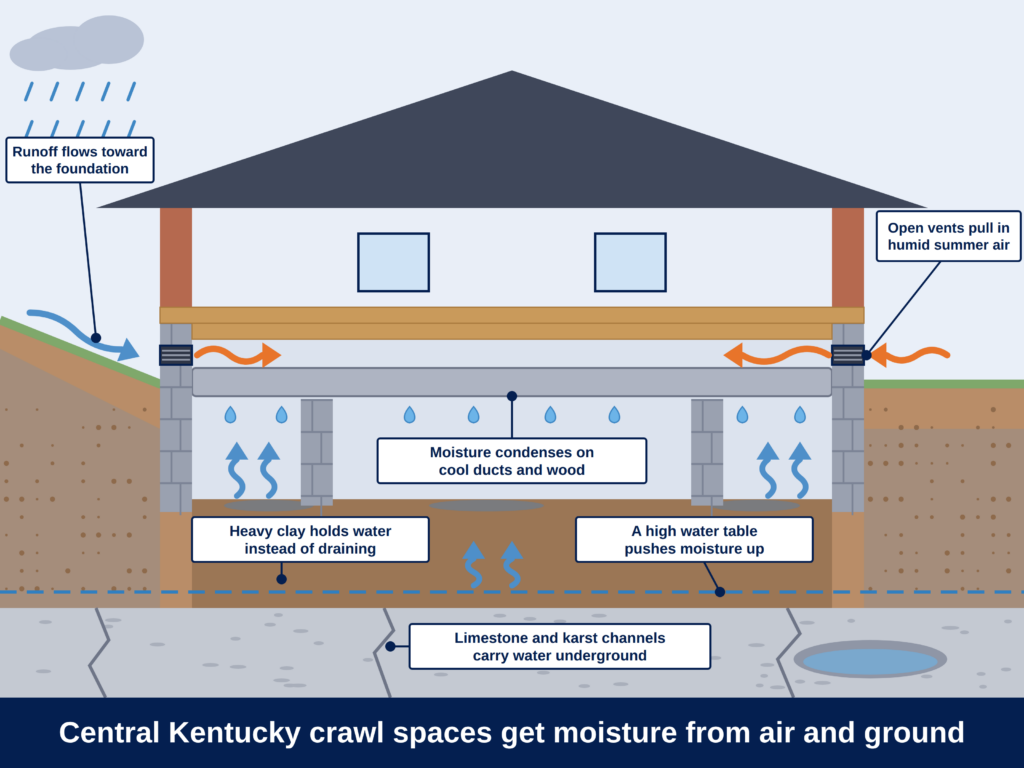
Lexington sits on limestone bedrock with heavy clay soil above it. Clay holds water instead of draining it, and after a long spring rain the ground around a foundation can stay saturated for days. Karst features in the rock can send water underground in ways you cannot see from the yard.

Many older Lexington homes were built on block or stone foundations and piers with open vents, which was the standard idea at the time. In a humid summer, those vents pull warm, wet air into a cool crawl space. The moisture condenses on the wood and the ductwork and settles into the insulation.

In hillside and older neighborhoods, runoff pushes toward the foundation and a high water table after storms brings moisture up from below. Encapsulation deals with the air and the ground together, which is why it works where venting and a loose plastic sheet did not.

What a Sealed Crawl Space Delivers

Here is what you can expect once the system is in place and working.

Humidity Below 60%

A sealed space with a dehumidifier stays below the humidity level where mold and wood rot thrive.

A 30-Mil Moisture Barrier

The heavy barrier blocks the ground vapor that a thin liner lets through, and it holds up to technicians and storage.

Lower Energy Use

Many homeowners see lower energy use because the HVAC no longer fights damp air. Results depend on the home.

Warmer, Firmer Floors

Dry framing and insulated walls take the chill off the floors above and protect the structure from moisture damage.

Sealed vs. Vented Crawl Space: What Changes When the Vents Close

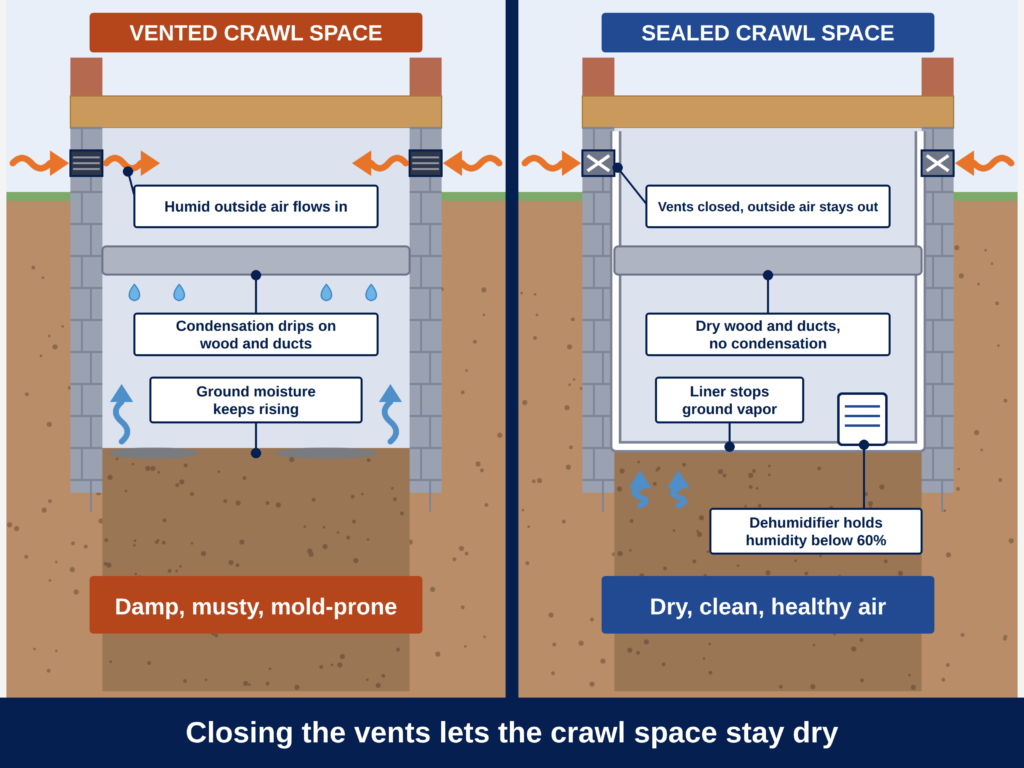
A vented crawl space relies on outside air to dry itself out. In Kentucky that rarely works, because the outside air is often more humid than the air under the house. Warm summer air meets cooler framing and soil, and the water ends up on the wood.

A sealed crawl space treats the area as part of the home’s conditioned envelope. The vents are closed, the barrier covers the ground and walls, and the dehumidifier keeps humidity in check.

Sealed vs. Vented Crawl Space: What Changes When the Vents Close

Crawl Space Encapsulation vs. Vapor Barrier vs. Waterproofing

These three services overlap, so here is how they differ. Your inspection tells us which one, or which combination, fits your crawl space.

Vapor barrier only

Waterproofing

Full encapsulation

Main job

Vapor barrier only

Block moisture rising from the soil

Waterproofing

Manage standing or flowing water

Full encapsulation

Seal and condition the whole space

Best for

Vapor barrier only

Dry crawl spaces with ground moisture

Waterproofing

Standing water, seepage and flooding

Full encapsulation

Humid, musty or mold-prone crawl spaces

Vents

Vapor barrier only

Usually left as they are

Waterproofing

Depends on the design

Full encapsulation

Closed and air-sealed

Humidity control

Vapor barrier only

Not included

Waterproofing

Dehumidifier can be built in

Full encapsulation

Dehumidifier included

Learn more

Vapor barrier only

Waterproofing

Full encapsulation

This page

Why Lexington Homeowners Choose Full Crawl Space Encapsulation

People often call after trying something smaller. Here is why they end up here.

How Crawl Space Encapsulation Works, Start to Finish

Here is what happens from your first call to the finished crawl space.

1

Free inspection

We check the soil, framing, vents, access door, ductwork and any signs of water.

2

Written scope and estimate

You get a clear plan that lists what is included and what it will cost. The estimate sets out the schedule, so you know what to expect.

3

Barrier and sealing

The 30-mil polyethylene barrier goes down on the floor and up the walls. Seams, piers and penetrations are sealed, and vents are closed and air-sealed.

4

Insulation, dehumidifier and door

Wall insulation, the dehumidifier and a tight access door finish the system. We confirm it drains properly and is ready to run.

5

Final walkthrough

We show you the finished space and explain how to check the dehumidifier. Most jobs take one to a few days.

How Much Does Crawl Space Encapsulation Cost in Lexington?

No two crawl spaces are the same. These factors move the number.

The free inspection gives you a written price for your crawl space. If you would like to spread it out, ask about flexible financing when we visit.

Encapsulation, or Just One Piece of It?

Building the Right Scope

If a smaller fix will do the job, we say so. If the crawl space needs more, we explain why and show you the steps.

Pairing Crawl Space Encapsulation With Other Services

A crawl space is part of the foundation, so the rest of the foundation matters. If your inspection shows cracks, settling or moving walls, we may recommend foundation repair so the barrier is not sealed over a structural problem.

If your home also has a basement, we can look at both areas in one visit. Water from outside often gets into both, and basement waterproofing keeps one dry space from feeding the other.

Ready for a Dry, Sealed Crawl Space in Lexington?

Book a free, no-obligation inspection and get a written plan for your crawl space. We will tell you what the space needs and what it does not, and talk through financing if you want it.

Proven by Results, Recognized for Excellence

Crawl Space Encapsulation FAQs for Lexington Homeowners

It depends on the size of the crawl space, how easy it is to reach, what shape it is in and whether it needs drainage, repairs or a larger dehumidifier. After a free inspection we give you a written estimate for your home.

A vapor barrier covers the ground to slow moisture. Encapsulation goes further. It covers the walls, seals the vents and door, and adds drainage, insulation and a dehumidifier as the space calls for.

Yes, in most cases. The barrier keeps moisture out, and the dehumidifier handles the moisture that still gets in through the house. It drains away, so you are not emptying a bucket.

Not on their own. Closing vents without a ground barrier and humidity control can trap damp air. Full encapsulation seals the vents as part of a complete system.

Encapsulation stops the moisture that feeds mold, but it does not remove growth that is already there. If we find mold during the inspection, we explain the options and how to handle it first.

Most jobs take one to a few days. The estimate sets out the schedule for your home, including any prep or repairs.

We deal with the water first. Drainage and sometimes a sump pump come before the barrier, so the new system is not sitting in a wet space.

Yes. You can pay over time with flexible financing, and we walk you through the options at your estimate. You can also read about it on our financing page.

Areas We Serve

Reed’s Home Solutions installs crawl space encapsulation in Lexington, Fayette County and throughout Central Kentucky.

Scroll to Top