
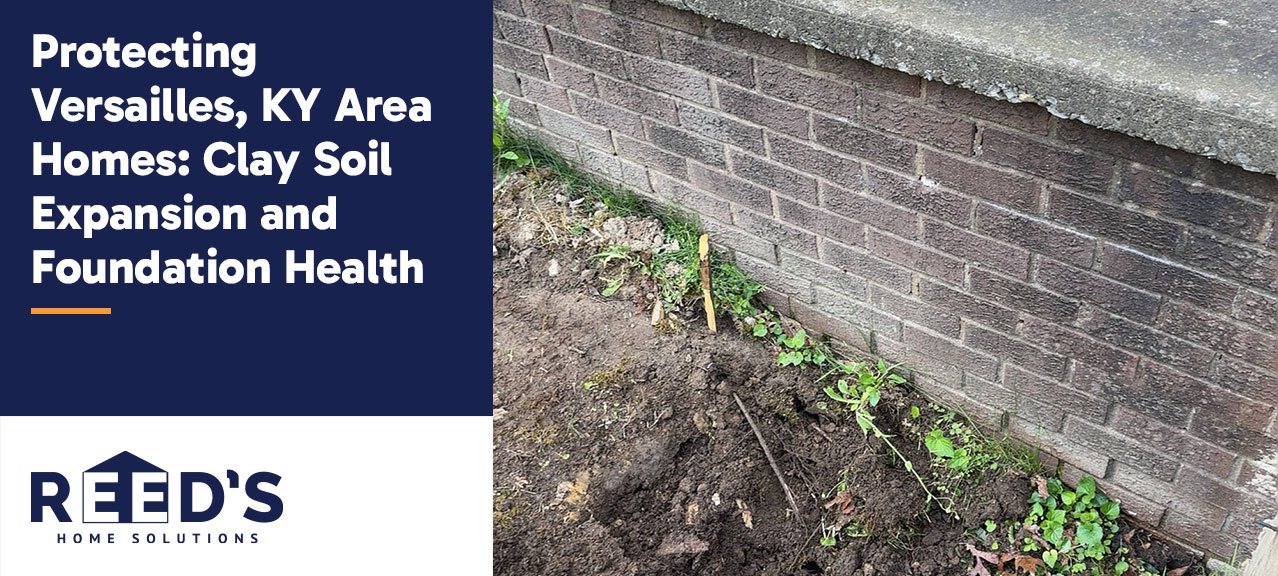
Homes in Versailles, KY, and across Woodford County sit on some of the most reactive soil in the region. During wet seasons, regional clay expands up to 15% in volume, generating immense hydrostatic pressure that lifts, cracks, and stresses foundations from below.
A wet season followed by a dry spell triggers a cycle of damage that worsens over time. Left unaddressed, warning signs like sticking doors, drywall cracks, and bowing basement walls escalate into catastrophic structural failures.
Reed’s Home Solutions specializes in foundation repair in Versailles dealing with these exact conditions. This guide outlines how expansive clay damages your foundation, key warning signs, and the engineered solutions available to restore your home’s structural integrity.
Understanding Expansive Clay Soil in Versailles, KY
What Makes Bluegrass Region Clay So Reactive
Versailles sits in the heart of Kentucky’s Bluegrass region, where clay formed over millions of years through the weathering of Ordovician limestones and shales. These fine-grained particles retain water far longer than sand or loamy soil. While sandy soil drains quickly and maintains a stable volume, clay absorbs moisture, expands, and then shrinks as it dries—creating ongoing volatility beneath concrete footings.
How Clay Mineralogy Affects Foundations
The primary driver of this movement is smectite (including montmorillonite), a clay mineral group with a layered crystalline structure. Water molecules slip between these layers, expanding the material up to 15 times its dry volume and generating pressures exceeding 30,000 pounds per square foot.
Expansive clay beneath Central Kentucky homes can expand up to 10% during prolonged wet periods. This upward and lateral force places enormous stress on concrete slabs and basement walls until visible structural damage occurs.
The Shrink-Swell Cycle
The soil shrink-swell cycle drives long-term foundation damage in Woodford County:
- Wet Seasons: Clay absorbs water, expands, and exerts upward and inward pressure on the foundation.
- Dry Spells: Clay contracts and pulls away, leaving hollow voids beneath foundation footings.
- Settlement: The unsupported foundation settles unevenly into these voids.
Even minor shifts of 1/4 inch accumulate frame stress over time. The repetitive cycling—not a single storm—causes structural failure.
[Wet Season: Clay Expands] –> Pushes Upward/Inward (Hydrostatic Pressure)
|
[Dry Season: Clay Shrinks] –> Leaves Voids Beneath Footings
|
[Foundation Drops] –> Differential Settlement & Cracks
Hydrostatic Pressure on Foundation Walls
Water weighs approximately 60 pounds per cubic foot. After heavy rain or snowmelt, water saturates the soil around your foundation. Clay holds onto this water, combining water weight with swelling soil to push directly against basement walls. This hydrostatic pressure forces moisture through concrete pores and drives walls inward.
Warning Signs of Clay Soil Foundation Damage
Catching foundation problems early minimizes repair costs. Watch for these common indicators in your Versailles home:
- Sticking Doors and Windows: Uneven settlement warps house framing out of square, causing door frames to jam and window latches to misalign.
- Stair-Step Cracks in Masonry: Diagonal cracks following mortar lines in exterior brick or block walls signal differential settlement beneath the footings.
- Diagonal Drywall Cracks: Fractures extending from the top corners of interior door and window frames indicate active frame stress.
- Bowing Basement Walls: Horizontal cracks near the mid-point of a basement wall accompanied by an inward curve point to severe hydrostatic pressure.
- Gaps Along Baseboards: Floorboards separating from baseboards or walls pulling away from ceilings reveal active floor dropping.
Water Management to Control Soil Movement
Controlling moisture around your foundation is the first defense against clay soil movement.
Proper Gutter and Downspout Placement
- Extend downspouts at least 4 to 6 feet away from the foundation (underground drain lines are preferred).
- Assign no more than 30 to 40 linear feet of gutter per downspout to prevent overflow.
- Stop roof runoff from pooling directly against foundation walls, which spikes hydrostatic pressure.
Lawn Grading and Surface Drainage
- Slope lawn surfaces away from the home at a minimum of 0.5 inches per foot for 10 feet (a 2- to 3-inch drop).
- Install intentionally graded swales to channel surface water around the home naturally.
Subsurface Drainage Systems
Exterior and interior French drains intercept groundwater using perforated pipe, gravel, and filter fabric. Because Woodford County clay drains slowly, drainage systems require precise pitch and professional placement to prevent clogging.
Foundation Repair Solutions from Reed’s Home Solutions
When structural movement occurs, permanent engineered repairs are necessary to stabilize the home.
Foundation Pier Installation
Foundation piers bypass unstable surface clay by transferring the home’s weight down to solid bedrock or load-bearing soil strata.
- Excavation: Small access holes are dug around the foundation footings.
- Bracket Attachment: Heavy-duty steel brackets are secured to the bottom of the footing.
- Driving Piers: Hydraulic equipment drives steel pier sections deep into the earth until reaching competent load-bearing strata.
- Load Transfer & Lifting: The building’s weight is transferred onto the piers, stabilizing the foundation and frequently lifting it back toward its original position.
Push Piers vs. Helical Piers
| Feature | Push Piers | Helical Piers |
| Drive Method | Driven hydraulically using building weight | Mechanically screwed using torque motors |
| Best Used For | Heavy, multi-story structures | Light to medium structures (porches, additions, homes) |
| Depth Capability | 25 to 60+ feet (drives until bedrock) | Adjustable based on precise torque readings |
| Angle Option | Vertical only | Vertical or angled (tiebacks) |
| Primary Benefit | Reaches deep bedrock regardless of soil layers | Works exceptionally well in loose, wet, or shallow soils |
Wall Anchor Systems for Bowing Walls
For walls bowed more than 2 inches, wall anchors counteract severe hydrostatic pressure by connecting the foundation wall to stable earth outside the excavation zone.
[Interior Steel Plate] <=== Steel Rod ===> [Exterior Earth Anchor in Stable Soil]
(Basement Wall) (10+ Feet Away in Yard)
- An interior steel plate is mounted to the basement wall.
- A heavy-duty steel rod passes through the wall into the yard.
- An exterior anchor plate is driven into stable soil 10+ feet away.
- The system is tensioned, immediately locking the wall in place and allowing technicians to pull the wall back toward plumb over time.
Carbon Fiber Reinforcement
For basement walls bowing less than 2 inches inward, carbon fiber straps offer a low-profile, cost-effective repair.
- Extreme Strength: Carbon fiber fabric possesses tensile strength up to 10 times stronger than structural steel and will never stretch or corrode.
- Epoxy Rivet Technology: Straps are embedded in high-strength epoxy directly onto prepared concrete walls, distributing lateral loads evenly.
- Top & Bottom Anchors: Top brackets secure to rim joists, while bottom anchors lock into the concrete floor slab to prevent shear movement.
- Low Profile: Straps sit virtually flush against the wall and can be painted over immediately.
Restore Your Foundation Today
Clay soil beneath your Versailles home will continue to expand, contract, and press against your foundation every season. Early intervention prevents minor settling from becoming an expensive structural emergency.
Reed’s Home Solutions offers free, comprehensive foundation evaluations across Woodford County. Our technicians assess wall deflection, floor levels, crack patterns, and soil drainage to design a customized repair plan for your home.
Contact Reed’s Home Solutions today to schedule your free foundation estimate and secure your home’s foundation for good.