
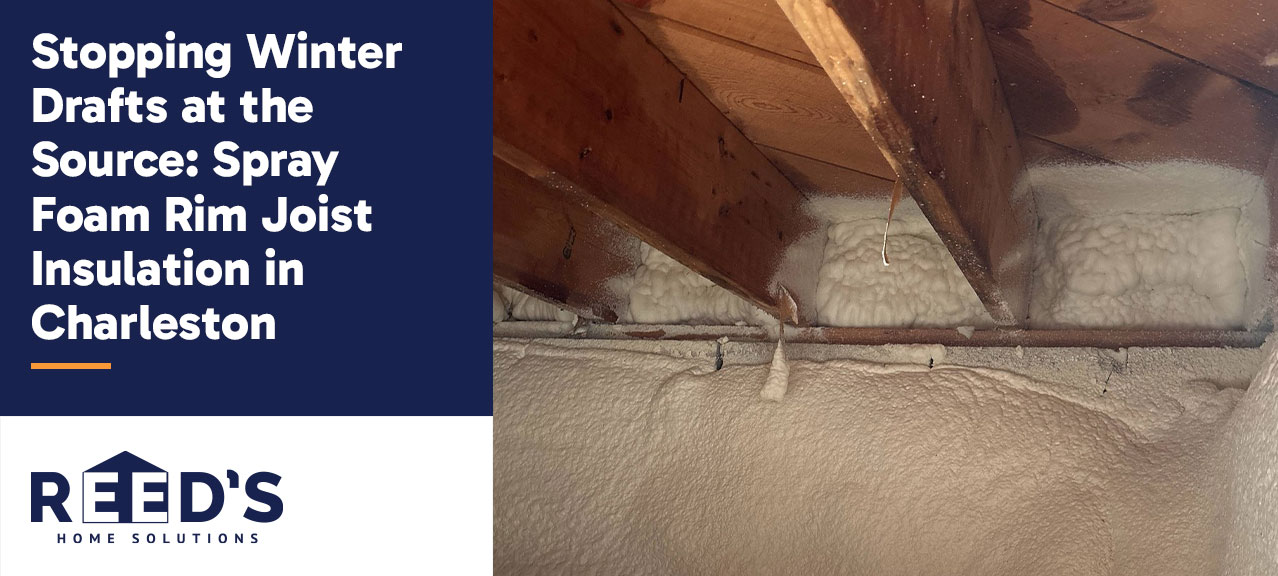
Cold floors, persistent drafts near baseboards, and heating bills that never seem to come down — these are problems many Charleston homeowners deal with every winter. What most don’t realize is that the rim joist area, where your foundation meets the floor framing, is often the hidden source of the trouble. Holes, cracks, and gaps in this area can account for 40% or more of your home’s total energy loss.
Spray foam rim joist insulation in Charleston, WV seals this weak point directly, creating an airtight barrier that stops cold air at its source. Properly sealing these gaps can cut your heating and cooling costs by 10 to 20 percent annually. Reed’s Home Solutions specializes in rim joist insulation that eliminates drafts, strengthens your Charleston home insulation, and keeps your home comfortable all year long.
What Are Rim Joists and Why Are They So Drafty?
Where Rim Joists Are Located in Your Home
The rim joist runs along the outer edge of your floor framing, sitting directly on top of your foundation wall. This horizontal board forms the perimeter where your floor structure meets your exterior walls. Head down to your unfinished basement and look up toward the ceiling. The rim joist is right there at the edge, holding the ends of your floor joists in place and transferring the load from your floor down to the foundation.
Common Gaps and Penetrations That Let Cold Air In
The rim joist area is where several building components come together at once — the rim joist itself, the mudsill, the subfloor, and the foundation wall. Where these materials meet, gaps and cracks naturally form. On top of that, builders drill through the sill plate and rim joist to run essential utilities. Here is what typically passes through this area:
- Electrical wires
- Plumbing pipes and water supply lines
- Drain pipes
- Ductwork
Each one of those penetrations is an opening where outside air can seep directly into your home. Even the wood corners and joints themselves allow steady air leakage. The rim joist area can cause more air infiltration than all your windows combined.
How Rim Joists Contribute to the Stack Effect
Think of your home like a chimney during winter. Warm air rises and escapes through gaps at the top, while cold outside air gets pulled in through cracks at the bottom. Rim joist leaks sit right at that lower entry point, making them the primary source of cold air drawn in by this stack effect. Because this area is the most depressurized part of your home during heating season, even small gaps contribute heavily to the problem.
Cold air enters through unsealed rim joists, moves up through your subfloor, and creates those icy floors you feel on winter mornings. Small leaks add up fast — essentially the same as leaving a window open all year long. Sealing rim joists is one of the highest-impact energy improvements you can make to stop winter drafts at their source.
Traditional Insulation vs. Closed-Cell Spray Foam for Rim Joists
Why Fiberglass Batts Fail at Sealing Rim Joists
Fiberglass batts are still found in many older Charleston homes, but they fall short at the one thing that matters most in rim joist areas: air sealing. The material is air permeable. Warm, humid interior air moves right through it and contacts the cold wood surface behind it, where condensation forms. Left unaddressed, that moisture leads to mold growth and wood rot.
There is another problem. Fiberglass acts as an effective filter, trapping dirt, pollen, and dust carried by the air moving through it. Mold doesn’t grow on the fiberglass fibers themselves, but it thrives on the debris that builds up there. Pull out old rim joist fiberglass and you’ll often find black spots — a clear sign of ongoing air leaks and moisture problems. Building science experts no longer recommend fiberglass batts for rim joist insulation.
How Closed-Cell Spray Foam Creates an Airtight Barrier
Closed-cell spray foam solves the problem that fiberglass simply cannot. The material expands to fill every gap, crack, and irregular cavity in the rim joist area. Batt insulation compresses poorly into these spaces, and rigid foam requires extensive cutting and fitting to get close. Spray foam handles both the insulation and air sealing in one application.
Once cured, the foam creates a permanent airtight barrier. Blower door tests conducted before and after rim joist spray foam installation consistently show 15 to 25% reductions in overall air leakage rates. That reduction translates directly into fewer drafts and lower heating costs throughout the winter.
R-Value and Moisture Resistance Comparison
The performance numbers tell a straightforward story. Closed-cell spray foam delivers R-6 to R-7 per inch. Fiberglass batts provide only R-3.2 to R-3.5 per inch. Beyond the R-value gap, closed-cell foam also acts as a vapor retarder, blocking water vapor transmission and stopping condensation from forming on cold wood surfaces. Fiberglass absorbs moisture and requires a separate vapor barrier to do what spray foam handles on its own.
For Charleston, WV home insulation, that combination matters. Closed-cell spray foam creates both an airtight and vapor-tight barrier in a single step, making it the right choice for rim joist areas where moisture control and air sealing are equally important.
Benefits of Spray Foam Rim Joist Insulation in Charleston
Sealing your rim joists with spray foam does more than just stop drafts. Charleston homeowners who address this problem see real improvements in comfort, energy costs, and home health. Here is what you can expect:
- Warmer floors and fewer drafts: Cold air seeps into your basement through uninsulated rim joists, then rises through the subfloor to chill your main-level floors. Some homeowners notice a temperature difference of ten to fifteen degrees between their basement ceiling and the floor above, even with the heat running constantly. Spray foam fills every gap and creates a complete thermal envelope, putting an end to cold floors and drafts near baseboards.
- Lower heating and cooling bills: Uninsulated rim joists account for fifteen to twenty percent of total heat loss in a home. Sealing them with spray foam can reduce annual heating and cooling costs by approximately 19.3%. Charleston homeowners often waste between three hundred and six hundred dollars every year on energy lost through this area alone. That is money staying in your pocket once the rim joists are properly sealed.
- Moisture control and mold prevention: Closed-cell spray foam blocks water vapor from entering wall cavities where condensation forms. The material does not absorb moisture, which means no rot and no mold growth — even in Charleston’s humid conditions. Without excess moisture, mold simply has no opportunity to take hold. The foam bonds permanently to wood and stays effective for the lifetime of your home.
- Pest entry points eliminated: Insects and rodents get into homes through the same gaps and cracks that let cold air in. Cured polyurethane foam offers no nesting opportunity and holds no appeal to pests — unlike fiberglass, which rodents will nest in and damage over time.
- Improved indoor air quality: Sealing the rim joist area reduces unwanted airflow, which means fewer outdoor allergens, dust, and pollutants making their way into your living space. A healthier indoor environment starts with stopping what comes in through the gaps.
The Reed’s Home Solutions Rim Joist Insulation Process
Initial inspection and identification of problem areas
Every job starts with a thorough inspection. Our technicians examine your rim joist area for moisture damage, rot, and pest activity before any work begins. We check the sill plate condition, noting whether it contacts masonry without proper moisture protection. Dryer vents, electrical wiring, plumbing pipes, and HVAC lines all get identified and accounted for before insulation installation moves forward.
Removing old or damaged insulation materials
Old fiberglass batts must come out completely — no exceptions. Our crew removes all existing insulation, clears out cobwebs and debris, and makes sure every surface is clean and dry. Spray foam needs direct contact with wood to bond properly and create an effective air seal. Skipping this step compromises the entire installation.
Precision spray foam application and sealing
Reed’s applies closed-cell spray foam at 2 to 3 inches thick, achieving R-12 to R-18. The foam expands to fill every gap, crack, and irregularity in the rim joist area, creating an air barrier and thermal barrier at the same time. It bonds directly to wood and masonry surfaces, holding firm without sagging or shifting over time.
Quality check and final walkthrough
Once the foam has cured, our technicians go back through and seal any remaining gaps where the foam meets the sill plate or floor joists. This attention to detail matters. Rim joist sealing alone typically reduces total house air leakage by 10 to 20 percent — and we make sure your home captures every bit of that improvement.
Contact Reed’s Home Solutions Today
Uninsulated rim joists are one of the most overlooked sources of energy loss in Charleston homes. The good news is that the fix is straightforward. Reed’s Home Solutions provides professional spray foam rim joist insulation that stops winter drafts, cuts heating bills by up to 20%, and keeps moisture problems from taking hold.
Your home deserves a solution that actually works. Contact Reed’s Home Solutions today to schedule your free inspection and take the first step toward a warmer, more efficient home.