
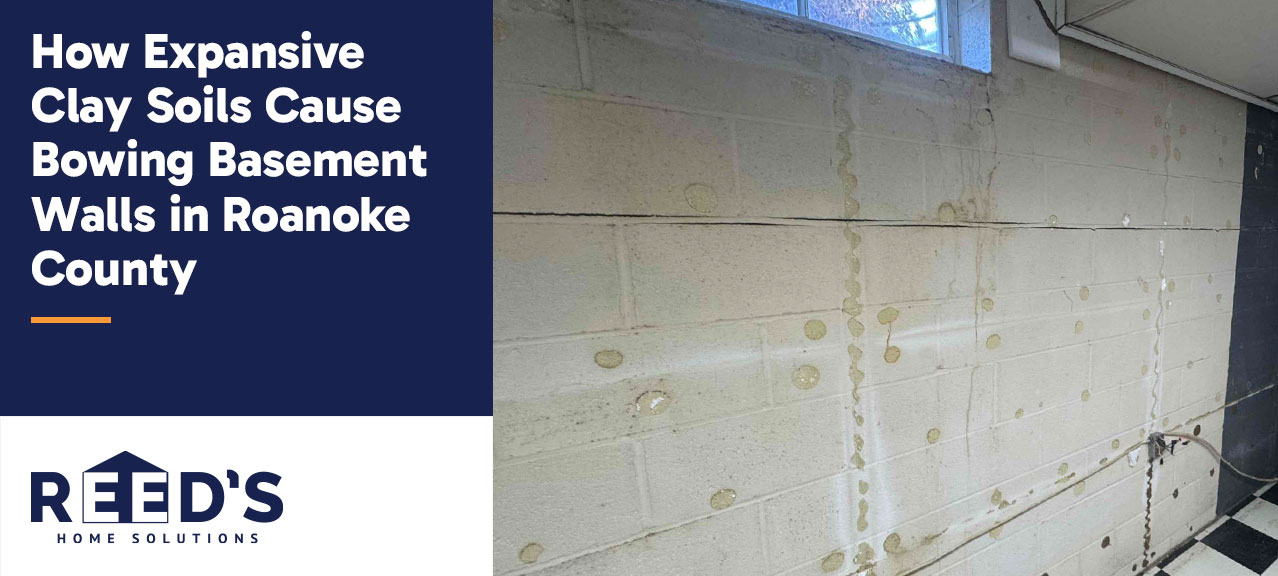
Bowing basement walls in Roanoke County are more than an eyesore — they are a warning sign that your foundation is under serious structural stress. The region’s clay-heavy soil swells when saturated and shrinks during dry periods, pushing constantly against your foundation walls. That repeated push-and-pull from expansive clay soil foundation damage weakens wall integrity over time, leading to horizontal cracks, inward bulging, and eventual wall failure.
If you have noticed changes in your basement walls, it is important to understand what is causing them and get the problem addressed right away. Ignoring clay soil basement problems only allows conditions to worsen — and the longer hydrostatic pressure works against your basement walls, the more costly and complicated the repair becomes.
This guide explains how Roanoke Valley’s soil conditions cause wall bowing, what warning signs to look for, and what basement wall repair Roanoke solutions are available to stabilize your foundation.
What Expansive Clay Soil Is and Why It’s Common in Roanoke County
Soil That Swells When Wet and Shrinks When Dry
Expansive clay soil contains specific minerals that change dramatically in volume based on moisture content. Clay particles absorb water between their crystalline layers when the ground becomes saturated, causing the soil to swell. When conditions dry out, those same particles release water and contract — leaving visible cracks in the soil surface.
The volume changes involved are not minor. Expansive soils commonly expand 10 percent or more by volume with moisture increase. Highly expansive clays can exert swelling pressures exceeding 20,000 to 30,000 pounds per square foot. Montmorillonite, the most problematic clay mineral found in this region, can swell up to fifteen times its dry volume. Concrete foundation walls simply were not designed to flex or bend under that kind of force.
Virginia’s climate creates moisture fluctuations that typically reach approximately 4 feet below the surface. Soil moisture stabilizes below that depth. After several wet-dry cycles — roughly the fifth cycle — the soil fabric becomes disoriented and expansibility begins to diminish. The problem is that your foundation takes the brunt of that damage long before equilibrium is ever reached.
Why Roanoke Valley Has Significant Clay Content
Roanoke County’s soil profile is clay-rich throughout much of the region. The Roanoke soil series consists of clayey fluvial sediments with slow to very slow permeability. Soil layers in this area contain silty clay loam that transitions to dense clay at depths of 12 to 40 inches — sitting right at the zone where foundation walls experience the most lateral pressure.
These clay deposits formed from weathered parent rocks in the Blue Ridge and Piedmont regions. X-ray diffraction studies of Virginia Blue Ridge and Piedmont soil profiles show that soils developed from calcium-aluminum rich rocks or basic rocks with poor drainage contain kaolin and montmorillonite clay minerals. Hornblende and augite serve as the chief source materials driving montmorillonite formation.
How Clay Soil Differs from Sandy or Well-Draining Soils
Sandy soils and clay soils behave in nearly opposite ways. Coarse sand can infiltrate water at up to 10 inches per hour, while clay infiltration can be less than 0.05 inches per hour. Sandy soils drain quickly, hold less water, and create far less swelling pressure against foundations.
Clay soils, with over 25 percent clay content, hold high proportions of water due to capillary attraction between their tiny particles. Water does not drain away after a rain event — it lingers near your foundation, keeping swelling pressure active for extended periods. That is what makes clay-heavy ground conditions in Roanoke County particularly hard on basement walls.
How Expansive Clay Soil Causes Bowing Basement Walls
Heavy rain saturates soil and causes swelling
Roanoke County’s clay-heavy ground soaks up rainwater quickly — and then holds onto it. Clay minerals absorb water molecules between their crystalline layers, forcing the soil to expand. During rainy seasons or prolonged wet periods, clay soil can expand up to 15% in volume. Some pure montmorillonite samples swell up to 15 times their original volume. That expansion creates upward and lateral pressure measured in tons per square foot against your foundation. Saturated soil surrounding your basement weighs over 120 pounds per cubic foot — that is a tremendous amount of force pressing against your walls with nowhere to go.
Swelling soil pushes against foundation walls laterally
Wet clay has one direction to move when it expands beside your basement wall — inward. Expansive clay soils exert enormous pressure on foundation walls, and when that pressure exceeds what the wall can handle, the wall begins to give. The force of expansion can reach 20,000 pounds per square foot or greater. Concrete was never designed to flex or bend under that kind of horizontal load, and the result is walls that gradually lean and bulge inward.
Repeated wet and dry cycles weaken wall structure over time
Each season brings another round of soil swelling and shrinking, creating what amounts to a “roller coaster” effect on your foundation. Even small movements of just 1/4 inch accumulate and cause significant structural damage over time. Each expansion-contraction cycle stresses existing fractures and opens up new vulnerable areas. Clay soil movement intensifies with seasonal weather patterns, meaning the problem doesn’t stay the same — it gets worse every year it goes unaddressed.
Hydrostatic pressure adds force in poorly drained yards
Hydrostatic pressure is the force that standing water exerts against your basement walls. Water weighs approximately 60 pounds per cubic foot, and when it cannot drain away, that weight presses against your foundation. Saturated soil surrounding your home increases in both weight and volume, adding inward force to your basement walls. Because clay retains moisture far longer than sandy soil, that pressure stays elevated long after a rain event ends — keeping your walls under stress even during dry spells.
Foundation settling vs. bowing basement walls
These two problems are often confused, but they are not the same. Foundation settling is vertical — the home sinks downward when the soil beneath it cannot provide adequate support. Bowing basement walls are a lateral problem — soil pressure pushes horizontally against the wall face, causing it to lean or bulge inward rather than drop. Both are serious, but they require different solutions. Knowing which problem you have is the first step toward getting it fixed.
Recognizing the Warning Signs of Bowing Basement Walls
Knowing what to look for can make a significant difference. Bowing basement walls don’t announce themselves all at once — they give warning signs that show up gradually, and catching them early is the key to avoiding major structural failure.
Horizontal Cracks Running Across the Wall
Horizontal cracks are the most serious type of foundation crack you can find in your basement. These cracks typically appear at mid-wall height and run the full length of the wall, a clear indication that the wall is bending under lateral soil pressure. This is not something to monitor and revisit later. Horizontal cracks are always a cause for concern and require prompt inspection by a foundation repair contractor. When the crack exceeds 1/8 inch in width and horizontal wall movement reaches 1/2 inch or more, the situation demands immediate attention.
Stair-Step Cracks in Block Foundation Walls
Stair-step cracks follow the mortar joints in block foundations, creating a diagonal pattern that steps up or down along the masonry units. Differential settlement and hydrostatic pressure both cause uneven shifts in masonry foundations, and stair-step cracking is how those shifts show up. These cracks are particularly dangerous when they run along mortar joints, which are critical to your foundation’s overall integrity.
Wall Appears to Lean or Bulge Inward
Stand at one end of your basement wall and look down its length. A bowing wall will show a visible curve or bulge, with the middle section appearing closer to you than the top and bottom. Any wall that has moved more than 2 inches inward needs urgent repair — the window for straightening rather than simply stabilizing begins to close quickly beyond that point.
Doors or Windows Near the Basement Sticking
Basement wall movement doesn’t stay in the basement. When foundation walls shift, the effects travel upward through your home’s framing, causing door and window frames to fall slightly out of square. The result is doors that stick, windows that resist opening, or visible gaps at the tops of doorframes.
Visible Gaps Where the Wall Meets the Floor or Ceiling
Gaps between the wall and floor rarely appear on their own. When foundation walls bow inward under lateral soil and hydrostatic pressure, they shift away from the floor system above them. The resulting gap tends to be wider at the top than the bottom, and horizontal cracking on the wall face typically accompanies it.
Why These Signs Indicate Structural Stress
Bowing walls don’t get better on their own — they only get worse. Soil pressure continues pushing against the foundation, and cracks grow longer, wider, or both. Once bowing starts, it tends to accelerate, and the combined weight of the soil and the home above becomes more than the wall can handle. If you spot any of these warning signs, it’s important to find the source of the problem and get it addressed right away. Waiting allows pressure to build and turns a manageable repair into a much more serious one.
Repair Methods and Prevention for Bowing Basement Walls
Knowing the cause of bowing basement walls is only half the picture. The other half is getting the right repair in place before the damage gets worse. Several proven methods exist for stabilizing and straightening bowing walls — and the right choice depends on how far the wall has already moved.
Carbon Fiber Wall Reinforcement for Early-Stage Bowing
- Carbon fiber straps bond directly to the interior wall surface with structural epoxy, stabilizing walls that have bowed 2 inches or less. Installation involves preparing the wall surface, applying epoxy every 4 feet, securing vertical carbon fiber strips, and allowing the adhesive to cure. Carbon fiber exhibits tensile strength exceeding 195,000 PSI — roughly ten times stronger than steel by weight. This method stops lateral movement without any excavation or yard disruption.
It is worth noting that carbon fiber stabilizes the wall in its current position. It cannot straighten existing bowing. For walls already leaning inward significantly, a different approach is needed.
Steel I-Beam Bracing for Moderate Wall Movement
- Steel I-beams provide solid stabilization for walls that have bowed beyond 2 inches. These vertical beams are positioned every 4 to 6 feet along the affected wall and secured to the floor joists above and the foundation below. Systems like PowerBrace include zinc coating to prevent rust and feature an adjustable mechanism that allows for gradual wall straightening over time. No exterior excavation is required, making this a practical solution when yard space or property lines are a concern.
Wall Anchors for Significant Bowing
- Wall anchor systems are designed for walls with moderate to severe bowing. Interior steel plates connect to anchors buried in stable soil at least 10 feet outside your foundation, with steel rods running between them. Tension can be tightened gradually over time to pull the wall back toward its original vertical position. Wall anchors are the only repair method that actively straightens a bowing wall rather than simply holding it in place. Accessible yard space is required to install the exterior anchors.
Improving Drainage to Prevent Future Wall Pressure
Structural repairs address the damage already done. Drainage corrections address the source of the problem.
- Keep gutters clean and extend downspout discharge at least 6 feet away from your foundation
- Re-grade yard surfaces to slope away from your home
- Install French drains to channel water away from the foundation
- Remove invasive vegetation within 10 feet of foundation walls
Poor drainage keeps hydrostatic pressure working against your walls long after repairs are made. Without correcting it, the problem is likely to return.
Why Pairing Structural Repair with Drainage Work Matters
Structural wall repairs Roanoke stop immediate failure. But if water continues accumulating against basement walls, the same cycle of soil saturation and expansion that caused the original bowing will start again. Fixing drainage prevents future problems while foundation wall stabilization addresses the existing damage. Both repairs need to work together to protect your home against Roanoke County’s clay-heavy soil conditions.
Contact Reed’s Home Solutions for a Free Foundation Inspection
Bowing basement walls don’t get better on their own. The longer expansive clay soil continues pushing against your foundation, the more costly and complicated the repair becomes. Addressing both wall stabilization and drainage correction is the only way to stop existing damage and prevent it from coming back.
Reed’s Home Solutions knows Roanoke Valley’s soil conditions and what it takes to protect your foundation against them. Whether your walls show early-stage cracking or significant inward bowing, we have the expertise and solutions to get your home back on solid ground.
Schedule your free foundation inspection today. Don’t wait for minor cracks to become major structural failures.