
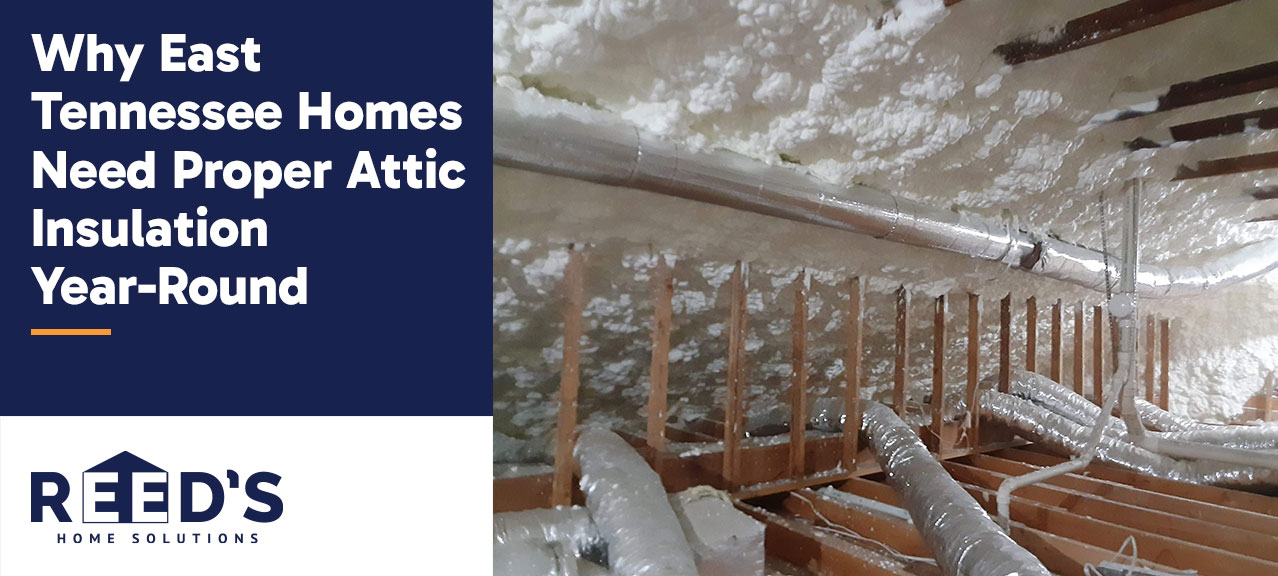
East Tennessee homeowners face a tough challenge that most people underestimate — their attic. Cold Appalachian winters and hot, humid summers put constant pressure on your home’s thermal performance year-round. Without adequate attic insulation and air sealing, the consequences add up fast: spiking energy bills, strained HVAC systems, ice dam risks, and uncomfortable temperature differences between floors. One Knoxville homeowner found their upstairs stayed approximately 10°F cooler during summer afternoons after spray foam was applied in the attic.
Your attic is your home’s most critical thermal barrier. It stands between your conditioned living space and the extreme temperatures outside — season after season.
Reed’s Home Solutions helps East Tennessee homeowners understand exactly why attic insulation matters year-round for energy efficiency, comfort, and home health. This guide covers how the right attic insulation protects against radiant heat transfer, prevents the stack effect, controls moisture, and delivers real savings on heating and cooling costs throughout every season.
East Tennessee Climate Profile and Your Attic’s Thermal Envelope
Understanding East Tennessee’s Humid Subtropical Climate
East Tennessee sits in a humid subtropical climate zone, and elevation plays a major role in how your home performs thermally. Temperature drops 3°F for every 1,000 feet you climb into the Smokies. Average annual temperatures range from 62°F at lower elevations to 44°F at the highest peaks. Warm, humid summers push temperatures into the upper 80s, while January lows average around 30°F in winter.
That combination creates relentless, year-round pressure on your attic. Summer pulls humid air up from the Gulf of Mexico, and winter pushes cold air masses in from the interior. Tennessee receives roughly 51 inches of precipitation annually, spread evenly across all seasons. Moisture management in your attic is just as important as temperature control — and the two problems are closely connected.
How the Stack Effect Works in Tennessee Homes
The stack effect operates like a chimney inside your home. Warm air rises and escapes through the attic, vents, or gaps in the building envelope. That upward movement creates negative pressure, which pulls replacement air in from below. Up to 50% of the air circulating through your home originates from your crawl space.
Here is what that looks like on a humid 80°F day at 80% relative humidity. Air enters your cooler crawl space and drops to 68°F. For every 1°F drop in temperature, relative humidity rises by 2.2%. That 12°F temperature drop pushes humidity up by 26.4%, reaching 106.4%. Excess moisture then condenses on surfaces, and mold thrives in conditions above 60% humidity.
This continuous air movement forces your HVAC system to run harder and longer. Unsealed gaps allow unfiltered air — carrying moisture, allergens, and mold spores — to circulate freely through your living areas.
Why Your Attic Is Your Home’s Critical Thermal Barrier
Your attic separates conditioned living space from the unconditioned space above, slowing heat loss in both directions. East Tennessee homes without proper attic insulation can lose up to 25% of heated air during winter. According to Department of Energy data, proper insulation can cut heating and cooling costs by up to 50%.
Both summer heat and winter moisture work against insulation over time. High temperatures compress insulation materials, and condensation from poor ventilation reduces their thermal resistance. The result is an attic that fails to protect your home when you need it most — during peak summer heat and the coldest winter months.
Summer Defense: Blocking Radiant Heat and Humidity
Superheated Attics in July and August
East Tennessee attics reach 130-150°F during peak summer months. A properly ventilated attic should stay only 10-20°F above outdoor temperature. On a 95°F afternoon, that means your attic should measure between 115-135°F. Readings consistently above 140°F signal ventilation failure and inadequate insulation — two problems that compound each other fast. Dark asphalt shingles absorb solar energy for eight or more hours daily, trapping heat in enclosed spaces with limited airflow. The result is an attic that behaves more like an oven than a buffer zone.
Radiant Heat Transfer Through Your Attic Ceiling
Thermal radiation is the primary way heat moves between your hot roof deck and your attic floor. The sun heats your roofing materials, which conduct that heat to the underside of the roof. From there, heat radiates across the air space directly into your attic insulation and the ceiling below.
Radiant barriers interrupt this transfer before it reaches your living space. Studies show properly installed radiant barriers reduce heat flux by 35-43%, with some configurations blocking up to 50% of radiant heat transfer. This single addition can make a noticeable difference in how hard your air conditioner has to work all summer long.
How Moisture Reduces Fiberglass Insulation Performance
East Tennessee’s humid summers don’t just make your home feel uncomfortable — they quietly destroy insulation performance. Fiberglass insulation loses effectiveness dramatically when damp. A 1.5% moisture increase can reduce R-value by up to 50%. At only 20% moisture absorption, insulation loses up to 55% of its thermal value. Humidity inside wall cavities above 30% promotes condensation, raising moisture levels further and creating conditions where mold grows.
Wet insulation is essentially failed insulation. It cannot be dried and restored to full performance.
Air Conditioner Strain and Rising Summer Cooling Bills
Poor attic insulation forces your air conditioner to fight two battles at once — removing heat generated inside your home and the massive heat load radiating down from a superheated attic. Your system runs longer cycles, putting extra wear on compressors and blower motors.
Proper insulation combined with air sealing reduces cooling energy use by 10-25% depending on existing conditions. Homeowners can reduce their summer cooling bills by up to 20% through attic insulation upgrades. That kind of savings adds up quickly over the course of a Tennessee summer.
Winter Defense: Stopping Heat Escape and Protecting Your Roof
Thermal Bridging and Heat Loss Through Ceiling Penetrations
Cold months expose every weakness in your attic insulation. Heat escapes at alarming rates — 25-40% of total heat loss occurs through the attic due to poor insulation and air leaks. The problem isn’t always missing insulation. Often, it’s the gaps and interruptions within it.
Thermal bridging happens when conductive materials like pipes, wires, and ducts penetrate your insulation layer, creating direct pathways for heat to escape. Wall studs alone can increase total heat loss by 15-20%, while roof joists and utility penetrations contribute an additional 2-5%. Unsealed electrical boxes, recessed lighting, and plumbing connections make it worse — each one acts as a convection pathway, pulling warm air directly into the attic space.
Even homes with existing insulation aren’t always protected. Outdated or improperly installed materials can leave your home just as vulnerable as having no insulation at all.
Preventing Ice Dams on East Tennessee Roofs
Here’s what happens when attic heat escapes during a Tennessee winter. Warmth rising from your living space heats the roof surface above freezing, while the eaves stay cold. Snow melts on the warmed section, flows downward, and refreezes at the cold edge — forming a dam. Water then backs up behind that dam and works its way into your attic, walls, and ceilings. The average homeowner claim for this type of water damage exceeds $3,000.
Heat reaches your roof through three paths:
- Conduction through insulation
- Convection through air leaks
- Radiation from warm interior surfaces
Air leakage is the leading cause of ice dam formation. Proper attic air sealing stops warmth from escaping to the roof surface before damage can occur.
How Heat Escape Drives Up Winter Heating Costs
Heat rises. When your attic isn’t properly insulated, your heating system works overtime just to maintain the temperature you set on the thermostat. Longer run times accelerate wear on equipment and push your energy bills higher every month. Homeowners who add attic insulation and air sealing save an average of 15% on heating and cooling costs — and those savings show up immediately.
Signs Your Attic Insulation Has Failed and How to Fix It
Unbalanced Room Temperatures Throughout Your Home
Upstairs bedrooms that feel 10-15°F warmer in summer or colder in winter are a clear sign something is wrong. Missing or settled insulation creates hot and cold zones throughout your home. If your thermostat is set correctly but certain rooms never seem comfortable, your attic insulation deserves a close look.
Spiking Utility Bills Without Rate Increases
Energy bills climbing month over month — without any rate increases from your utility company — point directly to insulation problems. Your HVAC system ends up running longer cycles just to maintain thermostat settings, compensating for heat loss in winter or heat gain in summer. That extra runtime costs you money every single month.
Constant HVAC Cycling and System Struggles
Short cycling — when your system turns on and off every few minutes instead of running full 15-20 minute cycles — signals your home simply cannot hold temperature. Constant running produces the same result. Both patterns accelerate equipment wear and drive up costs well before your system reaches the end of its expected lifespan.
Musty Attic Odors and Visible Mold Growth
A musty smell coming from your attic is a warning you should not ignore. It points to mold and mildew growth in wet insulation. Improperly installed insulation can block ventilation, trapping moisture and creating the exact conditions mold needs to spread. Wet insulation loses its effectiveness and requires full replacement — not just a patch.
Compressed or Dirty Insulation Below Recommended Depth
Dirty insulation is a sign air is moving through it rather than being stopped by it. Compressed material below 10-12 inches depth reduces thermal performance by one third or more. Both conditions leave your home far more exposed to heat loss and gain than most homeowners realize.
Why Air Sealing Comes Before Adding Insulation
Adding new insulation on top of unsealed gaps will not solve the problem. Air sealing must come first. Sealing gaps around pipes, wires, and penetrations stops convective heat loss and prevents the moisture condensation that leads to attic mold. It is a critical step — skipping it means new insulation will underperform from day one.
Spray Foam vs. Blown-In Insulation for East Tennessee Homes
Choosing the right insulation type matters just as much as having enough of it. Spray foam insulation provides an airtight seal with a higher R-value per inch, though it comes at a higher upfront cost. Blown-in fiberglass insulation or cellulose offers excellent coverage at a lower price point and can last well over 100 years. Reed’s Home Solutions evaluates your specific situation and recommends the right solution for your East Tennessee home.
Contact Reed’s Home Solutions for a Free Attic Insulation Estimate
Your attic works harder than any other part of your home. East Tennessee’s sweltering summers and freezing winters demand proper insulation and air sealing — not just for comfort, but for your HVAC system’s longevity, your roof’s protection, and your family’s health.
Reed’s Home Solutions evaluates your specific situation and recommends the right solution for your Knox County insulation project. Whether spray foam or blown-in insulation fits your needs best, we have the products and expertise to get the job done right.
The savings are real. The comfort is immediate. There is simply no reason to keep paying for energy your home is wasting through an unprotected attic.
Contact us today for a free inspection and estimate. Take the first step toward a more comfortable, energy-efficient home — season after season.