
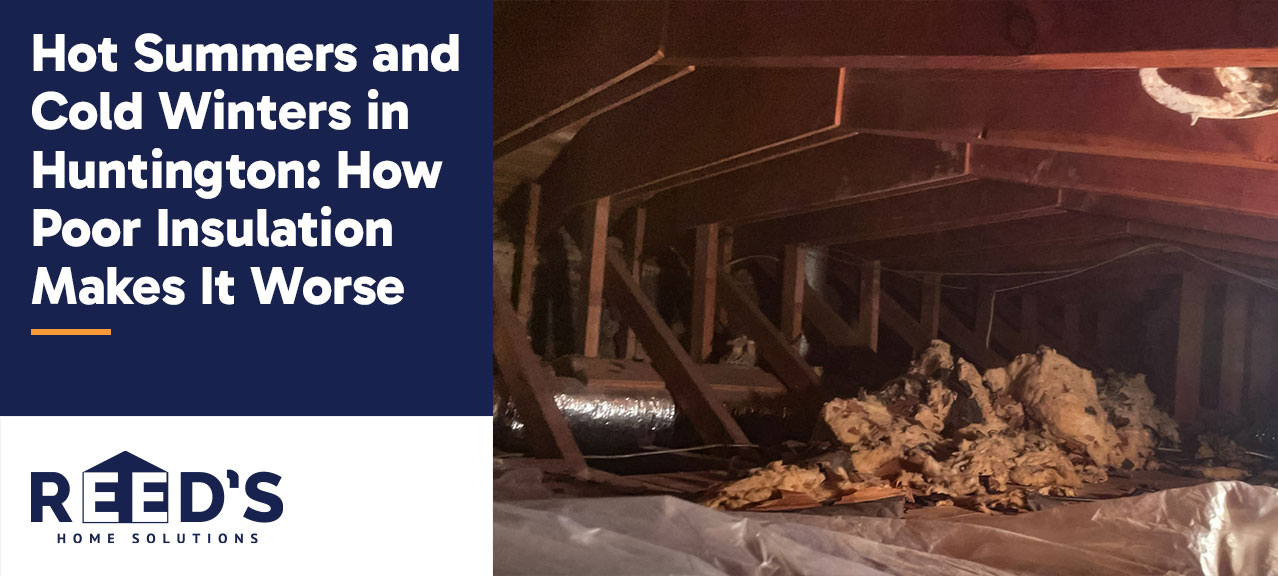
Poor home insulation can be responsible for up to 30% of your total energy loss, and Huntington homeowners feel that drain every single month. The Ohio River Valley throws both extremes at your home — hot, humid summers that turn attics into furnaces and brutal winters that pull warmth right out through unsealed gaps. Your HVAC system ends up working overtime year-round, and your utility bills climb whether you are running the heat or the air conditioning.
The problem runs deeper than comfort. Superheated attics bake your upper floors all summer long, while cold drafts and escaping heat strain your heating system through winter. These are not separate issues — they are two sides of the same problem: a home that is not properly insulated or sealed.
Recognizing the warning signs of poor insulation is the first step toward lower energy bills and a more comfortable home. Reed’s Home Solutions specializes in attic insulation, air sealing, and drafty home repair across the Tri-State area. This article breaks down exactly what Huntington’s climate does to a poorly insulated home — and what you can do about it.
The Ohio River Valley Weather Double-Whammy
Humidity and Seasonal Swings in Cabell County
Huntington sits in a climate battleground. The region has no mountains or coastline to soften the blow — just open exposure to Arctic air masses pushing down from Canada in winter and humid Gulf of Mexico air surging north every summer. That combination produces some of the most demanding seasonal extremes your home insulation will ever face.
Humidity makes every temperature swing worse. During summer heat waves, dewpoints climb into the mid-to-upper 70s, pushing heat index values between 100° and 110°F even when actual air temperatures sit at 90°F. Warm, humid air holds significantly more heat than dry air, so once that moisture works its way into your attic or walls, insulation performance drops fast — and mold finds exactly the environment it needs to grow. This creates a feedback loop: humidity traps heat, heat allows the air to retain even more moisture, and your home efficiency suffers the entire season.
Winters deliver equal punishment from the opposite direction. Arctic air masses drop temperatures sharply while your heating system battles to maintain indoor comfort. Without proper air sealing, that conditioned air you paid to heat doesn’t stay where you need it.
The Stack Effect in Older Huntington Homes
There is a physical process working against your home every hour of the day, whether it is January or July. Warm air rises naturally and escapes through ceiling cracks, attic bypasses, and gaps around light fixtures and plumbing penetrations. As that heated air exits through your attic, outdoor air gets pulled in through foundation cracks, basement windows, and rim joist spaces to replace it. This constant upward airflow — called the stack effect — can account for 40% of your annual heating costs.
Summer flips this cycle but doesn’t stop it. Cool, dense air from your air conditioning sinks and leaks out through lower-level openings, while hot attic air gets drawn down into your living space to fill the pressure void. Older Huntington homes with little to no air sealing experience this reverse stack effect intensely during July and August. The result is an HVAC system running nonstop that still can’t keep rooms comfortable.
The stack effect worsens with building height, larger temperature differentials, and more unsealed penetrations in your ceiling plane. Many Huntington homes were built long before modern building science understood these airflow dynamics. That is why professional air sealing and drafty home repair services are not optional extras — they are what stops this invisible energy drain for good.
Summer Nightmare: Superheated Attics and Humidity Traps
Attics That Hit 140°F and Higher
Attic temperatures in Huntington climb to dangerous levels every June through September. A properly ventilated attic should run only 10 to 20 degrees above outdoor air temperature, but attics in hot climates regularly reach 130°F to 160°F — even when outdoor temperatures hover around 95°F. Roof surfaces absorb solar heat all day long and radiate it directly into the attic space. Without adequate insulation, that thermal energy pushes straight down into your living rooms and bedrooms.
Upper-floor rooms take the worst of it. Second-story spaces become genuinely uncomfortable by mid-afternoon as the heat pressing down from above overwhelms whatever your cooling system can manage. Your AC runs and runs, but it is fighting a losing battle against a furnace sitting directly overhead.
What Moisture Does to Your Insulation
Humidity does not just make summer feel worse — it quietly destroys your insulation from the inside. Water conducts heat roughly 25 times more efficiently than air, so the moment moisture works its way into your insulation material, the R-value starts dropping. Damp insulation can lose up to 50% of its R-value, which means the thermal barrier you are counting on has become a heat conductor instead.
Fiberglass insulation darkens and saturates, while cellulose clumps and compresses. That compression opens gaps where air moves freely and heat transfers without resistance. Prolonged moisture exposure causes sagging and structural degradation. Mold growth can begin within 24 to 48 hours of moisture exposure, sending spores through your home’s air distribution system and creating a health concern on top of an energy problem.
The Real Cost of Overworked HVAC Equipment
Huntington summers force your air conditioning to do two jobs at once — cool the air and pull out excess humidity. When indoor humidity stays elevated, the air feels warmer than thermostats actually read, triggering longer and longer cooling cycles. Comfort stays out of reach no matter how low you set the thermostat.
That constant overwork takes a serious toll. Motors and compressors wear down under the stress, leading to repairs that stack up fast. Parts fail ahead of schedule. Some homeowners replace entire systems, only to watch brand-new equipment struggle under the same thermal load — because the insulation problem was never addressed in the first place.
Winter Struggles: Escaping Heat, Drafts, and Frozen Budget Spikes
Thermal Bridging and Unsealed Attic Bypasses
Summer is hard on a poorly insulated home, but winter reveals a different set of problems — and they can be just as costly. Thermal bridging accounts for approximately 30% of total heat loss in buildings, occurring when studs, joists, and rafters conduct warmth straight through your walls and ceilings. Wood framing provides only R-1.25 per inch, while fiberglass insulation delivers R-3.3 per inch. Heat moves through framing more than 2.5 times faster than through surrounding insulation. Your walls may look solid, but heat is finding its way out through every framing member.
Attic bypasses make things worse. These are hidden air pathways that allow warm air to continuously escape into unconditioned attic spaces — and they appear in more places than most homeowners realize:
- Chimneys and flue chases
- Ceiling light fixtures
- Heating ducts
- Kitchen and bath exhaust fans
- Plumbing penetrations
- Electrical wires and outlet boxes
Attic air sealing must address every one of these bypasses before adding insulation. Unsealed gaps turn insulation into giant air filters that collect dust while allowing heat to flee. More insulation on top of an unsealed attic floor simply will not solve the problem.
Ice Dams and Moisture Risk
Heat escaping into your attic creates another problem you can see from the outside. That warmth melts snow on roof surfaces while eaves remain below 32°F. Water flows downward until it hits those cold overhangs and refreezes, forming ice ridges that block drainage. Water then backs up behind these dams, finding any crack in the roof covering and flowing into attic spaces, then through ceiling insulation and down to stain your finishes. Moisture entering homes from ice dams leads to mold growth and respiratory problems. What looks like a roofing issue is often a direct result of poor attic insulation and air sealing.
Drafty Home Repair in the Tri-State Area
Drafts are one of the most noticeable signs that a home has not been properly sealed. Cold spots along interior walls, heating bills that climb without any change in usage, and rooms that never quite reach the thermostat setting — these are all signs of air leaking in and conditioned air leaking out. Sealing air leaks and replacing worn weather stripping can reduce heating costs by 5-30% depending on how severe the leakage is.
Many Huntington homeowners have lived with these drafts for years, assuming it is just how older homes feel in winter. That is not the case. Professional drafty home repair services identify these hidden pathways and restore consistent thermal comfort throughout your home — so you are not heating the outdoors all season long.
5 Telltale Signs Your Huntington Home Has Poor Insulation
Some insulation problems are obvious. Others hide behind walls and above ceilings, quietly draining energy and comfort until your utility bills make the problem impossible to ignore. If your Huntington home is showing any of these signs, it is time to get the problem inspected and addressed before it gets worse.
- Drastic Temperature Differences Between Floors: Upper floors running 8-10 degrees warmer than lower levels is normal. When that gap pushes past 10 degrees, inadequate insulation between floors or in the attic is allowing excessive heat transfer. Upstairs bedrooms bake in summer while basements feel like iceboxes, and no thermostat setting fixes that without addressing the insulation first.
- Unexplained Utility Bill Spikes: If your bills are climbing without any change in how you use energy, your insulation is likely failing. The EPA estimates that adding insulation and sealing air leaks can reduce heating and cooling costs by an average of 15%. That savings potential tells you how much energy a poorly insulated home wastes every month.
- Your HVAC Runs Constantly: A system that runs nonstop without ever reaching the thermostat setting is working against a thermal load it cannot overcome. Poor attic insulation allows heat to transfer faster than your AC can remove it, forcing it into continuous cycles that wear out equipment well before its time.
- Drafty Rooms and Cold Floors: Cold spots near exterior walls and floors noticeably colder than the rest of the room point to air leakage. Conditioned air is escaping, and outdoor air is taking its place. That is not a comfort issue — it is an insulation and air sealing problem.
- Musty Odors or Visible Moisture in the Attic: A persistent musty smell in your home often means moisture-damaged insulation. Wet insulation loses its effectiveness and cannot be restored — it requires full replacement. Visible water stains, compressed or clumped insulation, or mold growth on attic rafters all demand immediate attention.
If you spot any of these problems, it is important to find the source and get it taken care of right away. Left unaddressed, insulation failures escalate — and so do the repair costs that follow.
Take the Next Step Toward a More Comfortable Home
No HVAC upgrade will fix a home that leaks energy through poorly insulated attics, unsealed bypasses, and drafty walls. The equipment just works harder and wears out faster. Addressing the root cause is the only way to stop the cycle.
Reed’s Home Solutions helps Huntington homeowners identify exactly where their homes are losing energy and what it takes to fix it. From attic insulation and air sealing to drafty home repair across the Tri-State area, we have the products and expertise to restore comfort and reduce your energy costs — for good.
Everyone deserves to live in a home that stays cool in summer and warm in winter without sending utility bills through the roof. Your next step is simple: contact us today for a FREE insulation estimate and take the first step toward a home that finally works the way it should.