
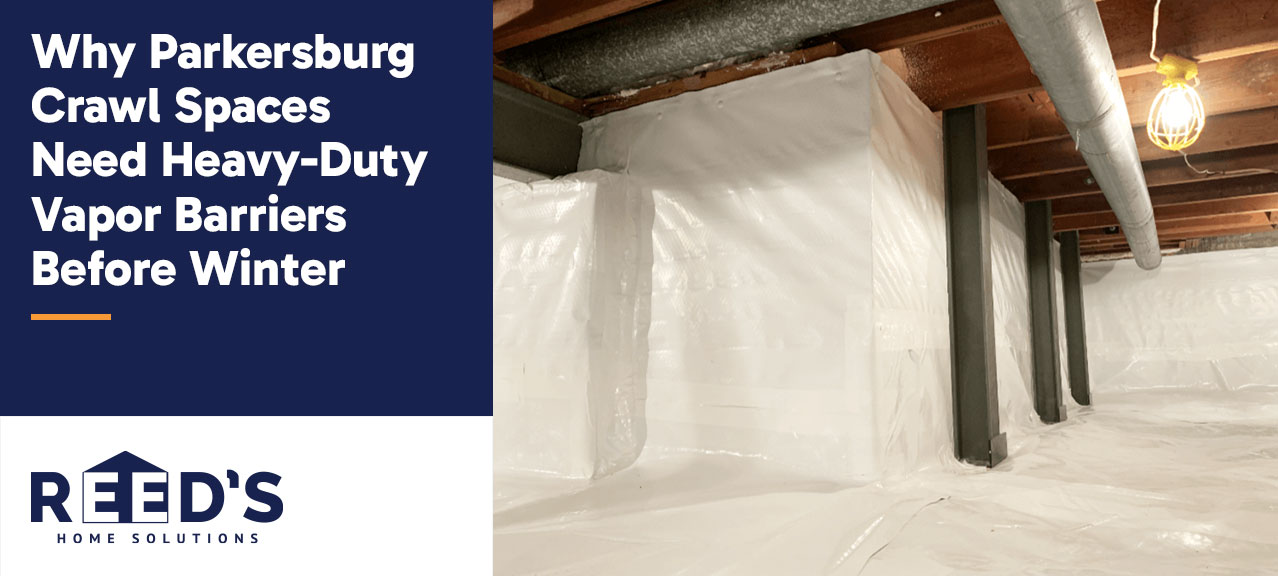
Ice-cold floors the moment winter arrives are not just a comfort problem. For many Parkersburg homeowners, the culprit is a missing or damaged crawl space vapor barrier sitting underneath their feet. Exposed soil holds moisture year-round, and without a proper barrier in place, that cold, damp air pushes straight up through your subfloor while your furnace runs constantly trying to compensate.
The Mid-Ohio Valley’s climate makes this worse than most areas. Ohio River humidity combined with the region’s freeze-thaw cycles puts uninsulated, unprotected crawl spaces at serious risk of condensation, wood rot, and mold growth every single winter.
A heavy-duty vapor barrier addresses this problem at the source. Whether your home needs crawl space encapsulation, basic crawl space moisture control, or full crawl space waterproofing, Reed’s Home Solutions helps Parkersburg, WV homeowners get their crawl spaces protected before the first hard freeze sets in.
Why a Crawl Space Vapor Barrier Matters Before Winter in Parkersburg
Winter doesn’t create crawl space moisture problems. It just makes the ones already there worse. Getting crawl space moisture control handled before temperatures drop gives you a drier, warmer, healthier home from November through March.
How a vapor barrier blocks moisture rising from exposed soil
Bare dirt under your home is anything but inactive. Soil beneath a house sits at or near 100% relative humidity nearly year-round, and that moisture constantly pushes upward into the crawl space air above it. A 1,000 square foot crawl space with exposed earth can release 10 to 15 gallons of water vapor every single day. A continuous, sealed polyethylene membrane over that soil cuts ground moisture input to less than a gallon a day once installed correctly. That one change makes a significant difference in what your home deals with all winter.
Why Mid-Ohio Valley humidity and cold surfaces cause condensation
Humid air doesn’t need rain to cause real damage. Warm, moisture-laden air moving through your crawl space hits cold foundation walls, ductwork, and framing, and wherever that air meets a surface at or below its dew point, it turns into liquid water on contact. Once relative humidity climbs past 60 percent, mold-favorable conditions develop within 24 to 48 hours. Parkersburg winters give that cycle plenty of opportunity to repeat.
Why are my floors cold in winter?
Cold air entering through vents or porous block walls settles against the underside of your subfloor and transfers straight into your living room floor. A 50-degree difference between outdoor and indoor temperatures — typical for a Mid-Ohio Valley January — creates enough upward pressure to pull cold crawl space air through every gap and penetration in your floor system. The result is floors that feel cold no matter how high you set the thermostat.
How damp wood and insulation lead to mold and rot
Waterlogged fiberglass batts sag, lose their R-value, and let cold air pass straight through to the floor above. Wood holding moisture content above 20 percent gives decay fungi exactly what they need to start consuming structural framing. The troubling part is that this damage often has no visible sign until a floor suddenly feels soft underfoot.
How the stack effect carries crawl space air upstairs
Warm indoor air rises and escapes through your attic and roof. The air replacing it gets drawn from the lowest available point — your crawl space. This exchange accounts for 40 to 50 percent of the air circulating on your first floor[62], carrying mold spores and musty odors into rooms your family uses every day. If you have noticed a stale or earthy smell indoors during winter, the crawl space is often the source.
How Thick Should a Crawl Space Vapor Barrier Be?
Choosing the right crawl space vapor barrier for a Parkersburg home comes down to a few practical factors: your soil conditions, how often someone enters the space, and whether HVAC equipment or storage will sit on top of it. Get this decision right, and the barrier protects your home for decades. Get it wrong, and you’re replacing torn plastic within a few years.
6 Mil vs. 20 Mil Vapor Barrier: Thickness, Durability, and Typical Uses
Residential code sets a 6 mil minimum, but that thin plastic tears easily on rocky or uneven ground. The 2021 IRC already requires 10 mil material under concrete slabs, which reflects how far the industry has moved beyond basic 6 mil sheeting. For crawl spaces, 10 to 20 mil polyethylene hits the practical sweet spot, and most homeowners land on at least 8 mil for durability that holds up long-term.
| Thickness | Typical Use | Lifespan |
|---|---|---|
| 6 mil | Temporary or very low-traffic coverage | A few years before replacement |
| 10-12 mil | Smooth ground, moderate access, popular DIY choice | 20+ years when installed properly |
| 20 mil | Rocky soil, frequent maintenance access, contractor-grade jobs | Longest service life among common options |
Why Reinforced Polyethylene Resists Punctures During Maintenance
Thickness alone doesn’t tell the whole story. String-reinforced polyethylene resists tearing far better than smooth film of the same mil rating. That difference matters every time an HVAC technician, plumber, or homeowner crawls across the floor for service work. Material classifications make this concrete: Class A barriers hold a minimum 45 lb/in tensile strength and 2,200 grams of puncture resistance, while Class C drops to just 475 grams. A heavy-duty vapor barrier built to Class A specs simply survives the daily wear that thinner, unreinforced sheeting cannot.
Why Sealed Seams and Secure Wall Attachments Matter
Even a 20 mil barrier underperforms when it’s laid down loose. Seams need at least 6 inches of overlap, though many professional installers use 12 inches for added security. The membrane should also run 6 to 12 inches up the foundation wall and seal tight against it. Any gap there lets vapor bypass the floor layer entirely, defeating the purpose of the barrier above it.
Vapor Barrier vs. Encapsulation: Which Does Your Home Need?
Not every Wood County crawl space needs the same solution. The real difference between a vapor barrier and full encapsulation comes down to how many moisture pathways are working against your home at once.
When a Ground Vapor Barrier Is Enough
A standalone vapor barrier handles the job when ground moisture is the only problem you’re dealing with. Dry soil conditions, minimal venting, no condensation on ductwork, and summer humidity readings that stay below 65 percent even with vents open all point toward a barrier being enough. If that describes your crawl space, covering the exposed dirt may be the only step needed, without the added cost of sealing everything else.
When Sealed Walls, Vents, and Humidity Control Are Needed
A vapor barrier alone won’t fix everything once humidity climbs past 60 percent, condensation appears on cold surfaces, or a musty smell starts drifting into your living space. One study measured 77 percent average relative humidity in a vented crawl space with a 20 mil barrier installed. The same space, once sealed and encapsulated, dropped to 52 percent. Full crawl space encapsulation for Parkersburg, WV homes includes sealed vents, wall insulation, and a dehumidifier holding humidity between 50 and 55 percent, well below the 60 percent threshold the EPA ties to mold risk.
When Crawl Space Waterproofing Must Come First
Standing water, puddles, or active seepage change the order of operations entirely. Putting a vapor barrier down over active water just traps it. A drainage system and sump pump need to go in first. A properly sized sump pit sits 2 to 3 feet deep, with discharge piped at least 10 feet away from the foundation so water doesn’t recirculate back toward the house. Skipping this step is one of the most common reasons West Virginia homeowners end up with crawl space mold months after installation.
How Insulation and Pipe Protection Round Out Your Winter Plan
- Ductwork and water line insulation keeps energy and plumbing protected through freeze-thaw cycles, reducing heat loss and the risk of frozen pipes.
- Moisture-tolerant foam board on foundation walls keeps humid air off cold surfaces where condensation starts, adding another layer of protection your crawl space needs through a West Virginia winter.
Winterize Your Crawl Space With Reed’s Home Solutions
There is no reason to wait until temperatures drop to find out what is happening under your home. Reed’s Home Solutions makes it straightforward to get your crawl space assessed and protected before winter arrives.
Signs to Check Now
Grab a flashlight and take a walk through your crawl space. You are looking for:
- Musty odors drifting up from below
- Torn, missing, or loose plastic on the ground
- Standing water or damp soil visible on the crawl space floor
- Sagging or springy floors above the crawl space
- Visible mold on framing, insulation, or the foundation walls
Any one of these points toward crawl space mold West Virginia homes develop when moisture goes unchecked. Spotting the problem now gives you time to fix it properly, not rush it in the middle of a freeze.
Why Scheduling Before Freezing Weather Matters
Once temperatures drop, ground conditions get harder to work with and project waitlists fill up quickly. Booking your crawl space winterization now keeps your project on schedule and gets materials installed while conditions are still workable.
What Our Inspection Covers
Our inspector reviews your specific concerns, examines the full crawl space, and puts together a clear plan before presenting findings and a same-day quote. We look at the vapor barrier condition, foundation walls, insulation, ductwork, and any standing water or active seepage. Nothing gets overlooked.
Serving Parkersburg, Vienna, Williamstown, and Wood County
Reed’s Home Solutions serves homeowners throughout Parkersburg, Vienna, Williamstown, and the surrounding Wood County area, including nearby Marietta, Ohio. If you are in the Mid-Ohio Valley, we are your local crawl space specialist.
Questions Worth Asking
Before any work begins, ask about material thickness, whether seams get taped rather than just overlapped, and what warranty covers the labor, not just the product itself. A quality installation backed by a solid warranty is what separates a long-term fix from a short-term patch.
Schedule Your Free Crawl Space Inspection
Free, no-obligation inspections are available now. Contact Reed’s Home Solutions today and take the first step toward a warmer, drier, healthier home before winter sets in.
Conclusion
Moisture problems under your floors don’t wait for winter to begin. They’re already there. Cold weather just makes them impossible to ignore.
A crawl space vapor barrier is one of the most cost-effective ways Parkersburg homeowners can protect their comfort, their structure, and their indoor air quality at once. The cost of installing a heavy-duty barrier is a fraction of what rotted framing or mold remediation will run you down the road. Acting before the first hard freeze makes far more sense than dealing with the damage after the fact.
Reed’s Home Solutions is ready to help. Schedule your free crawl space inspection today and take the first step toward a drier, warmer, healthier home this winter.
CALL US TODAY