
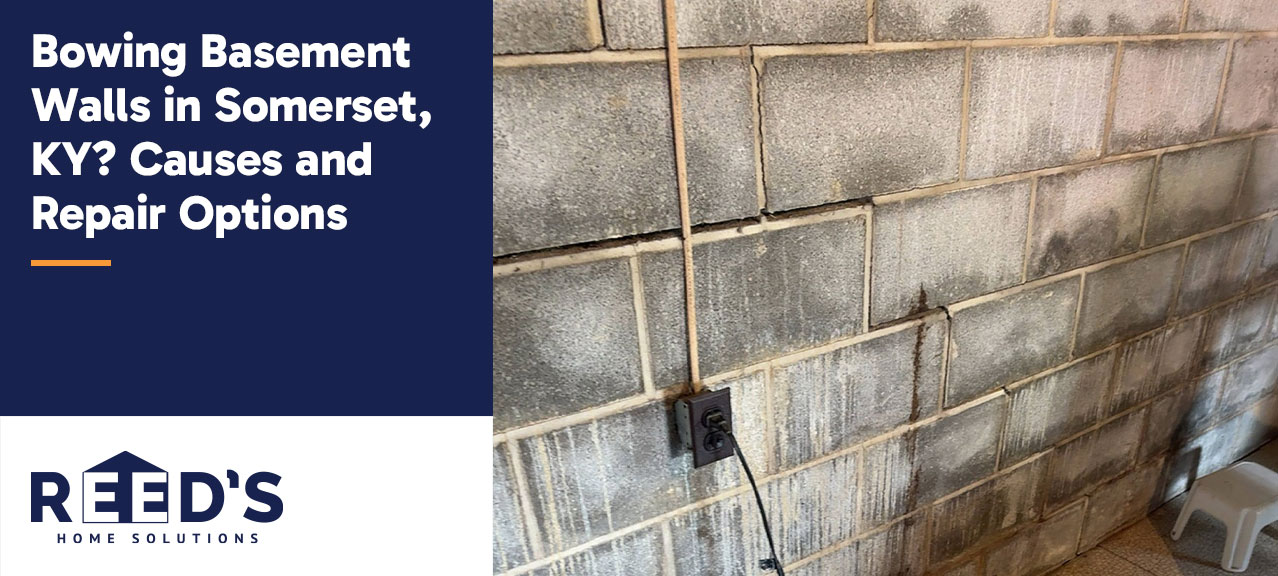
Bowing basement walls are one of the most serious structural problems a Somerset, KY homeowner can face — and the damage gets worse with every passing month. Every inch of inward movement reduces your repair options and raises the cost of fixing it. The primary cause behind these failures is hydrostatic pressure, which develops when water-saturated soil builds immense force against your basement walls, pushing them inward. Here in Pulaski County, that problem is made worse by expansive clay soil that swells dramatically when wet, adding significant lateral pressure directly against your foundation.
Left unaddressed, what starts as a small horizontal crack can progress into a full structural failure.
Reed’s Home Solutions specializes in foundation wall repair in Somerset, KY, offering engineered solutions like wall anchors and carbon fiber straps that Pulaski County homeowners can rely on. We’ll walk you through the causes of bowing walls that Pulaski County residents face and explain the proven repair methods that stop the damage for good. Contact us today for your free foundation wall inspection in Somerset, KY.
The Primary Culprit: Hydrostatic Pressure and Somerset’s Clay Soil
How Water Pressure Forces Walls Inward
Water weighs slightly more than 60 pounds per cubic foot. When the soil around your basement becomes saturated from heavy rain or snowmelt, tens of thousands of pounds of hydrostatic pressure can build against your foundation walls. That pressure acts directly on concrete or block walls from the outside, creating a constant sideways push that concrete simply was not designed to resist indefinitely. The deeper the saturation, the greater the pressure at that depth. Water keeps accumulating in soil pores, growing heavier and pressing harder — looking for any crack or weakness to push through.
Why Pulaski County Clay Soil Expands Against Foundations
The clay soil common throughout Pulaski County contains minerals like montmorillonite and bentonite that absorb water readily and expand significantly in volume. Geologists estimate that the average expansive clay generates over 5,500 pounds per square foot of pressure as it swells. During a wet season, your basement walls may be bearing more than two additional tons of lateral force. That repeated expansion and contraction cycle wears down structural components over time, causing horizontal cracks to form and water to infiltrate — often before you even notice a problem.
Inadequate Gutter and Downspout Drainage
Clogged or overflowing gutters dump water directly next to your foundation every time it rains. Downspouts that discharge only a few inches from your basement walls saturate the surrounding soil fast. Experts recommend extending downspouts at least 5 to 10 feet from the foundation to prevent chronic water buildup. Without those extensions, the same patch of soil gets saturated again and again with every rain event — keeping hydrostatic pressure against your walls almost constantly.
Heavy Equipment and Surcharge Loads
Surcharge loads — heavy equipment, stacked materials, or even dense landscaping placed close to your home — add lateral force on top of what the soil already exerts. Your foundation walls were not engineered to bear that additional horizontal pressure. Keeping heavy loads away from the perimeter of your home is a simple step that makes a real difference.
Freezing Soil Cycles in Kentucky Winters
Kentucky winters introduce another damaging force. When water in soil freezes, it expands by approximately 9%. That expansion pushes hard against foundation walls, causing cracking, leaning, or bowing. When temperatures rise and the ground thaws, gaps form beneath the foundation, leading to uneven settlement. This freeze-thaw cycle repeats throughout the winter months, forcing existing cracks deeper and steadily accelerating structural wear.
Reading the Signs Before Your Wall Collapses
Foundation walls rarely fail without warning. Knowing what to look for — and how serious each sign is — can be the difference between a straightforward repair and a complete structural emergency.
Stage 1: Horizontal Cracks in Basement Walls
Horizontal cracks are the earliest and most reliable sign of a bowing basement wall in Somerset, KY. These cracks typically appear midway up the wall and run the full length of the structure. In block foundations, stair-step cracks follow mortar joints in a zigzag pattern. Any horizontal crack wider than 1/8 inch signals active wall movement. Diagonal cracks running from corners toward the center point to uneven lateral pressure.
Do not wait to address these. A crack that seems minor today can widen significantly within a single wet season.
Stage 2: Inward Bowing or Bulging
- Walls deflecting less than 2 inches inward are still candidates for stabilization without full straightening.
- Deflections of 2 to 4 inches indicate high risk and seriously compromised structural stability.
- Visible bulging at the center of the wall means more than 1 inch of displacement has already occurred.
To check deflection yourself, drop a plumb line from the ceiling joist and measure the gap at the top, middle, and bottom of the wall. The difference tells you how far the wall has moved.
Stage 3: Wall Sliding Inward at the Base
Shearing is a more severe condition. It occurs when the bottom row of blocks stays anchored while upper sections shift inward. This happens when soil pressure forces the wall inward and a lower mortar joint breaks under the load. At this stage, the wall has lost much of its ability to resist horizontal pressure — and the stress concentrates at the base.
Stage 4: Top of Wall Separating from Floor Joists
Gaps forming between the top of your basement wall and the floor joists above are a serious warning sign. The gap is typically wider at the top than at the bottom. This stage comes just before complete wall collapse and calls for urgent professional foundation wall repair in Somerset, KY.
Warning Signs in Other Parts of Your Home
Foundation movement shows up elsewhere in the house, too. Watch for:
- Doors and windows that suddenly stick or refuse to close properly
- Diagonal cracks running from door and window corners
- Uneven or bouncy floors anywhere in the home
If you are seeing any combination of these problems, the source is likely your foundation. Getting it inspected right away can prevent the kind of damage that turns a manageable repair into a major structural project.
Why Quick DIY Fixes and Cosmetic Fillers Fail
It’s a natural instinct to reach for a quick fix. Many Somerset, KY homeowners dealing with foundation wall cracks purchase DIY repair kits that promise professional-grade results at a fraction of the cost. The problem is simple: these kits treat symptoms, not causes.
Caulk and Mortar Cannot Stop Soil Pressure
DIY foundation crack repair kits are designed for minor, surface-level cracks. They use epoxy or polyurethane in tube form with injection ports, but improper installation results in incomplete crack filling. Even when applied correctly, DIY methods fall short in creating strong bonds between the repair material and existing concrete, leaving the wall vulnerable to water intrusion.
Hydrostatic pressure and expansive clay soil can generate forces exceeding 100 pounds per square foot at typical basement depths. Caulk and mortar simply cannot hold against that kind of force. Worse, injecting epoxy into cracks that are still exposed to moisture can trap water inside the foundation — leading to mold growth or further structural weakening. The pressure outside your foundation keeps pushing regardless of what you apply to the inside.
Covering Bowing Walls Hides Dangerous Movement
Patching horizontal cracks with sealant ignores the structural pressure driving the visible damage. The wall continues moving while cosmetic repairs conceal how far along the problem has gotten. A wall that moved 1 inch over five years presents a very different risk than one that moved a quarter inch in three months — even if the total displacement looks similar.
Bowing basement walls require accurate measurement of displacement and professional judgment about whether movement is still active. That’s not something a DIY kit can tell you. Attempting these repairs on your own can also void future professional warranties and complicate insurance claims or home sales down the road.
Contact Reed’s Home Solutions for your free foundation wall inspection in Somerset, KY before attempting any repairs. Getting an expert assessment first is always the right move.
Engineered Repair Options from Reed’s Home Solutions
Caulk and surface patches won’t stop bowing walls — engineered solutions will. Reed’s Home Solutions provides foundation wall repair in Somerset, KY, with the right approach matched to your wall’s specific displacement and site conditions. Here’s what that looks like in practice:
- Carbon Fiber Wall Strapping: Carbon fiber straps are the right solution for walls bowing less than 2 inches. These high-strength woven straps achieve over 720 ksi tensile strength in dry fiber and 200 ksi in certified laminate, making them stronger than steel in tension. We apply straps approximately every 4 feet along affected walls using industrial-grade epoxy. Installation requires no excavation, typically completes in one day, and can be painted over for a clean, low-profile finish. Carbon fiber stabilizes walls in their current position, though it cannot straighten them back to original alignment.
- Wall Anchor Systems: For bowing walls with deflection exceeding 2 inches, wall anchors are the proven choice. Steel plates attach to your interior wall and connect via steel rods to anchor plates buried 10 to 12 feet into stable soil beyond the foundation. The system can be tightened periodically to gradually pull walls back toward plumb, providing permanent stabilization with only limited exterior excavation required.
- PowerBrace I-Beam Wall Braces: When exterior yard access is restricted, PowerBrace systems offer a reliable solution. Zinc-plated steel I-beams are installed vertically against failing walls, anchored to both the basement floor and floor joists above to prevent further movement. The patented adjustment mechanism allows tightening during dry seasons, giving the system the ability to potentially reverse wall failure over time.
Repairing bowing walls in Pulaski County without addressing the water source only creates a temporary fix. Extending downspouts at least 20 feet from the foundation and correcting yard grading prevents future hydrostatic pressure buildup. Interior drainage systems with sump pumps manage water before it ever has the chance to accumulate against your walls.
Start Protecting Your Foundation Today
Bowing basement walls don’t fix themselves. Hydrostatic pressure and expansive clay soil will keep pushing against your foundation regardless of what surface-level patches are applied. The longer wall movement goes unaddressed, the fewer options you have — and the higher the cost to fix it.
Reed’s Home Solutions provides engineered foundation wall repair in Somerset, KY that targets the root cause of the problem, not just the visible damage. Our wall anchors, carbon fiber straps, and PowerBrace systems are built to stop wall movement permanently and protect your home’s structural integrity for the long term.
There is simply no reason to wait while a structural problem gets worse beneath your feet. Contact us today for your free foundation wall inspection in Somerset, KY and take the first step toward a safer, more stable home.