
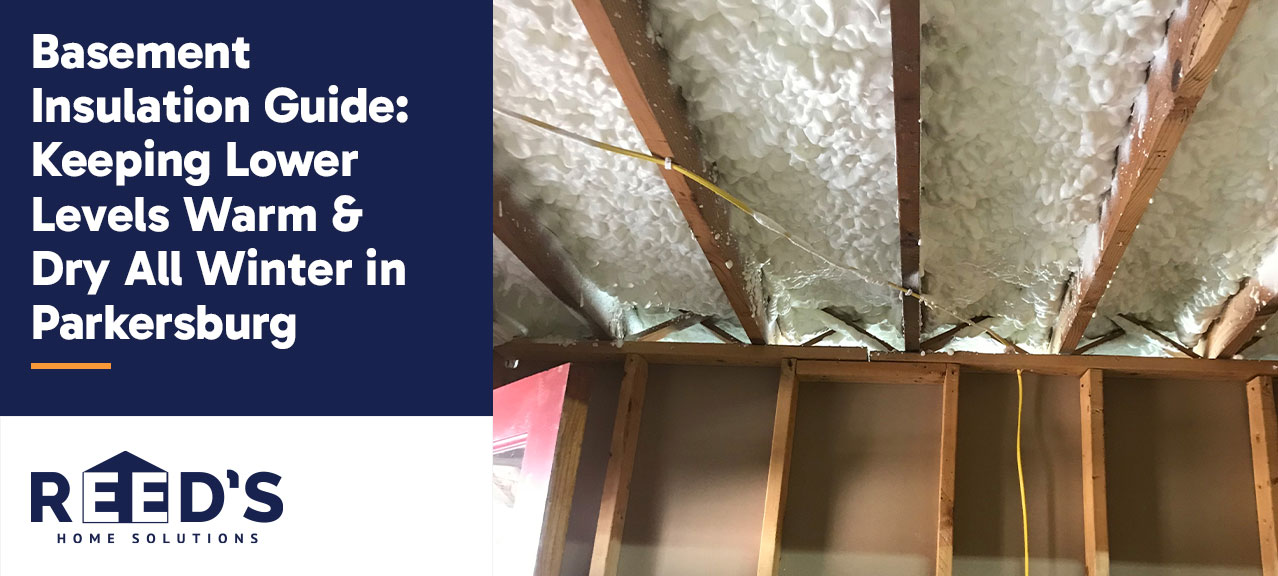
Cold rooms upstairs and heating bills that keep climbing — these are two problems Parkersburg homeowners shouldn’t have to live with. Basement insulation Parkersburg WV residents install can address both, and even targeted improvements make a noticeable difference in your home’s comfort. Cold weather makes basement issues worse in a hurry. The stack effect pulls warm air up and out of your home while cold air rushes in through unsealed rim joists, causing higher heating bills, cold floors, drafts, and moisture problems.
That’s why winter basement waterproofing West Virginia homeowners need works hand-in-hand with proper thermal protection. A dry basement and a well-insulated one go together — you can’t fully solve one without addressing the other.
Reed’s Home Solutions specializes in cold basement solutions Parkersburg homeowners trust. Our services include closed-cell spray foam insulation, rim joist air sealing, foundation wall insulation, and vapor barrier installation. This guide explains why basements get cold and damp in the first place, how to choose the right materials, which areas to target first, and what you can expect from professional basement insulation installation.
Why Parkersburg Basements Get So Cold and Damp in Winter
Basements lose heat through several different pathways. Knowing where heat escapes — and why moisture builds up — helps you focus on the right solutions for your Parkersburg home.
The Stack Effect and Unsealed Rim Joists
Heat rises. That’s simply what it does. Warm air travels upward through your home and escapes through gaps in the attic, and as it does, cold outdoor air gets pulled in from below to replace it. This cycle — known as the stack effect — runs continuously during winter, creating drafts along basement floors and putting constant pressure on your heating system.
Rim joists are where this problem hits hardest. Sitting at the point where your floor framing meets the foundation wall, rim joists in most homes built before 2000 have no insulation or air sealing at all. The U.S. Department of Energy estimates that rim joists account for up to 30% of a home’s total air leakage. In a typical 1,500-square-foot home, that’s 80 to 100 square feet of uninsulated surface sitting directly exposed to outdoor temperatures. During a January cold snap in Parkersburg, this means a 60-degree temperature difference across thin lumber with gaps running along every edge. That’s a significant amount of heat walking right out of your home.
Cold Foundation Walls and Heat Loss
Concrete and cinder block don’t hold heat the way wood and other building materials do. Foundation walls stay in direct contact with cold soil all winter long, and that soil transfers frigid temperatures straight into your basement. Contrary to what many homeowners assume, earth surrounding a foundation provides very little insulating value.
The result is uninsulated concrete walls that radiate cold constantly. A simple test tells you a lot — touch your basement walls. If they feel cold to the touch, your thermal envelope needs attention. Basements account for roughly 25 percent of a home’s total heat loss, which means your furnace is running longer, working harder, and spending more of your money just trying to keep the floors above you comfortable.
Condensation and Winter Humidity Risks in the Ohio River Valley
Cold walls and warm indoor air are a bad combination. When the two meet, moisture condenses on the surface of your basement walls. This happens more frequently in basements because concrete holds cold temperatures, below-grade spaces sit in cooler ground conditions year-round, and warm household air naturally moves downward. Add in everyday activities — cooking, showering, running laundry — and moisture levels in basement air climb even higher through winter months.
Left unmanaged, condensation creates exactly the conditions mold needs to take hold, according to the U.S. EPA. Musty odors, rotting framing, damaged insulation, and long-term structural problems all follow from untreated moisture. The Ohio River Valley’s winter climate makes this worse than most regions. Melting snow, heavy rain, and indoor humidity combine to keep basement moisture levels elevated throughout the season — which is why addressing condensation isn’t optional for Parkersburg homeowners. It’s essential.
Choosing the Right Materials for Basement Insulation
Not all insulation materials perform the same way in a basement. The wrong choice can create hidden moisture problems that don’t show up until significant damage has already occurred. Material selection is one of the most important decisions in any basement insulation Parkersburg WV project.
Why Traditional Fiberglass Batts Fail in Basements
Fiberglass batts are common in attics and walls — but they’re a poor fit for basements. The material holds moisture like a sponge, and as it becomes saturated, it loses its insulating ability. At only R-2.5 per inch, fiberglass starts out as one of the weaker options available, and it only gets worse from there.
The core problem is air permeability. Warm, humid interior air passes right through fiberglass and contacts the cold foundation wall behind it, where it condenses. The batts absorb that moisture and stay damp, creating exactly the conditions mold needs to grow. Paper facings on faced batts make this worse — they mold easily, as do the resins that bind the fibers together. Moisture problems develop even without visible leaks. When basements flood, fiberglass soaks up water and its dyes stain walls permanently.
Closed-Cell Spray Foam Insulation for Thermal Envelope Protection
Closed-cell spray foam is the top-performing option for basement insulation. It delivers R-7 per inch — the highest R-value available on the market. Applied at just 1.5 inches, it becomes a vapor barrier with permeance below 1.0 perm, meaning moisture cannot pass through it. It expands to fill gaps, cracks, and irregular surfaces, and it is 24 times less permeable to air infiltration than other insulation types. Homeowners who upgrade to closed-cell spray foam see energy savings averaging up to 50%.
Unlike fiberglass, closed-cell spray foam does not absorb water. Its inert polymers give mold nothing to feed on, making it a reliable long-term solution for below-grade applications.
Rigid Foam Board Insulation Options
Rigid foam boards offer a solid middle-ground option, with R-values ranging from R-3.5 to R-5 per inch. Three main types are used in below-grade installations:
- XPS (Extruded Polystyrene): Moisture-resistant and easy to cut and install
- EPS (Expanded Polystyrene): Affordable and widely available
- Polyiso: Highest R-value per inch among foam boards, with durable facers that support multiple installation methods
All three resist moisture effectively when panel edges are sealed with acrylic-latex caulk or foam sealant.
Vapor Barrier Requirements for Parkersburg Homes
Closed-cell spray foam and rigid foam boards already resist moisture on their own — no additional vapor barrier is needed with either material. Fiberglass and mineral wool, however, require polyethylene sheeting installed on the warm side.
One important caution: never install a Class I vapor retarder like 6-mil polyethylene directly against a concrete wall. Concrete holds moisture, and trapping it against the wall creates the perfect environment for mold to take hold. Getting the vapor barrier placement right matters just as much as choosing the right insulation material.
Key Areas to Insulate in Your Parkersburg Basement
Knowing what materials work is only part of the equation. Knowing exactly where to put them is what makes the real difference. These are the specific areas that matter most in your Parkersburg basement.
Rim Joist Air Sealing and Sill Plates
Rim joist cavities are among the largest sources of air leakage in any home. Each cavity needs to be measured individually, with insulation cut to fit snugly against the rim joist — no gaps, no shortcuts. Seal all edges with one-part foam, caulk, or mastic to create a tight, continuous barrier. Two-part spray foam works equally well and is often the faster option.
Before installing anything, surfaces need to be clean and free of dust or debris, which prevents proper adhesion. Key spots to address include:
- Gaps between the sill plate and rim joist — a common entry point for cold air
- Where the rim joist meets the subfloor — often overlooked but significant
- Penetrations for wiring and plumbing — small gaps that add up quickly
- Bay windows hanging off the foundation — these need special attention during sealing
Foundation Wall Insulation Coverage
Foundation walls need continuous insulation with absolutely no air gaps behind the panels. Rigid foam insulation attaches directly to basement walls using construction adhesive applied in serpentine patterns. Every panel seam must be sealed completely with caulk, foam, mastic, or flashing tape recommended by the manufacturer. R-value levels should meet or exceed what the International Energy Conservation Code requires for your location.
Basement Ceiling and Floor Insulation
Ceiling insulation in an unfinished basement keeps heat from escaping into unheated spaces and makes first-floor surfaces noticeably warmer. Floor insulation, on the other hand, only makes sense if the basement is being used as finished living space. Knowing which surfaces to prioritize helps you get the most out of your insulation investment.
Integration with Winter Basement Waterproofing Systems
Moisture issues need to be resolved before any insulation work begins. Insulating over an existing moisture problem doesn’t fix it — it hides it. Air sealing the rim joists stops the condensation cycle that leads to mold and rot. Winter basement waterproofing West Virginia contractors install — including vapor barriers and drainage systems — works alongside thermal protection to keep your basement dry and efficient year-round.
These systems are designed to complement each other. Waterproofing your basement or crawl space is only half the solution. Proper insulation and air sealing complete the picture.
The Benefits of Proper Basement Insulation Installation
Proper basement insulation does more than keep one room warm. It improves how your entire home performs — and the results show up quickly.
- Lower Heating Bills and Energy Savings: Air sealing and insulating basement rim joists alone saves homeowners an average of 15% on heating and cooling costs. Sealing gaps above the sill and along rim joists with closed-cell spray foam reduces heat loss by 30% to 40%. Insulating an unfinished basement wall to R-19 can cut annual heating bills by 20%. The money you save eventually pays for the insulation itself.
- Warmer Floors and More Comfortable Living Spaces: A warmer basement means warmer rooms directly above it. Spray foam or rigid foam board applied to the underside of the floor eliminates cold spots and drafts on your first floor, creating a noticeably more comfortable home throughout the winter months.
- Less Strain on Your Heating System: When your basement holds heat properly, your furnace doesn’t have to run as hard or as often. Reduced HVAC cycling extends the life of your equipment and lowers the stress on your heating system during the coldest months of the year.
- Better Indoor Air Quality and Moisture Control: Basement air doesn’t stay in the basement. The stack effect carries it upward into your living spaces. Proper air sealing and insulation block outdoor air and pests from entering, and controlling condensation reduces the risk of mold growth and water damage throughout your home.
Get Started on a Warmer, Drier Basement This Winter
Basement problems don’t resolve on their own. Cold floors, rising heating bills, and moisture issues only get worse as winter sets in — and the longer they go unaddressed, the more damage they can cause.
Proper basement insulation Parkersburg WV homeowners invest in delivers real results. Professional rim joist sealing and closed-cell spray foam application target the biggest sources of heat loss in your home, reducing heating bills by 20% to 40% while making every room above the basement noticeably more comfortable.
Reed’s Home Solutions brings proven expertise to every installation. We address both thermal protection and moisture control, because solving one without the other simply isn’t a complete solution. Our team is ready to assess your basement, identify the weak points, and recommend the right approach for your home and budget.
Contact us today for a free inspection and estimate. Take the first step toward a warmer, drier home this winter.