
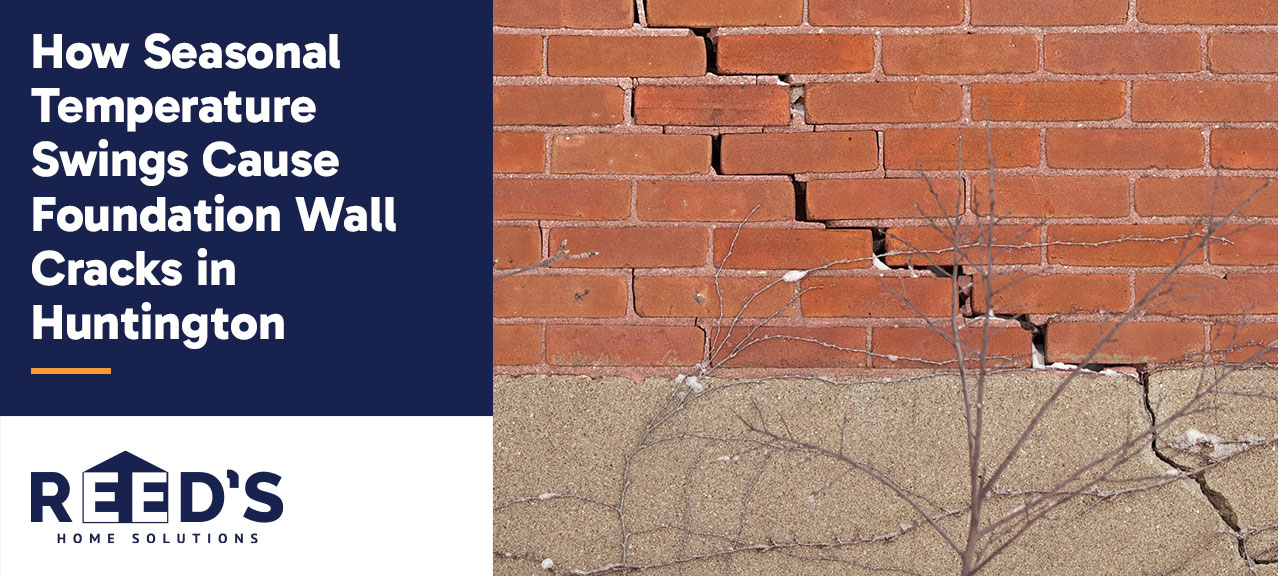
Foundation wall cracks Huntington, WV are one of the most common concerns homeowners face each spring — and the cause traces back to a straightforward fact: freezing water expands by roughly 9% in volume. That expansion pries hairline fractures wider with every freeze-thaw cycle, and Huntington’s Ohio River valley climate swings above and below freezing repeatedly rather than locking into one long, steady deep freeze. The result is that your basement wall cracks can widen through dozens of these cycles in a single winter.
Saturated clay soil adds to the problem. It generates hydrostatic pressure against your walls while shrink-swell cycles shift the support underneath them. A wet, shifting foundation is a serious issue — and one that gets worse the longer it goes unaddressed.
We help homeowners throughout Cabell County, Wayne County, and Barboursville identify seasonal foundation wall cracks early, whether that’s a horizontal crack in a basement wall or stair-step damage in a block wall. Catching these warning signs before small cracks become structural problems is exactly what we are here for.
Why Huntington’s Temperature Swings Crack Foundation Walls
Huntington’s Ohio River Valley Climate and Winter Temperature Swings
Huntington’s location in the Ohio River valley creates a winter pattern that is particularly hard on foundation walls. Rather than settling into one long, hard freeze, temperatures here tend to climb above 32°F during the day and drop back below it overnight. That back-and-forth keeps cycling concrete and soil through freeze-thaw stress all winter long.
Regions that repeatedly cross the freezing mark see more cracking than climates that simply stay frozen for months at a stretch. Cabell County, Wayne County, and the broader Tri-State region all share this valley climate pattern. Projections for the Ohio River basin also point toward a warmer, wetter future, with streamflow increases of 25 to 35 percent expected by 2099, which means more moisture feeding these cycles in the decades ahead.
Thermal Expansion and Contraction in Concrete and Block Walls
Concrete is always moving, even when everything looks still. Warmth causes it to expand; cold causes it to contract. The average coefficient of thermal expansion for concrete sits near 10 millionths per degree Celsius, which is enough to shift a 30.5-meter section by roughly 1.7 centimeters across a 38-degree Celsius temperature swing. Concrete masonry units behave similarly, moving at a coefficient near 0.0000045 inches per inch per degree Fahrenheit, and masonry surfaces can swing more than 100°F between summer and winter in a single year.
The real problem is restraint. A poured concrete wall or concrete block wall is held in place along its footing and floor framing, so it cannot expand or contract freely. That restraint turns ordinary thermal movement into stress — and stress, repeated enough times, becomes a crack.
Freeze-Thaw Foundation Damage: Water Expands About 9% as It Freezes
Water expanding 9% in volume as it freezes does not sound like much, but consider where that water is sitting — inside the pores of a poured concrete wall or the mortar joints of a concrete block wall. When that expansion has nowhere to go, it pushes against the surrounding material. Once the pressure exceeds the tensile strength of the concrete or mortar, a crack opens.
That crack then becomes a collection point for the next round of water. Each freeze widens it a little more, and a hairline line that seemed minor in October can turn into a visible vertical crack by spring after dozens of cycles through a single winter.
Frost Heave: Soil Lifts and Settles Unevenly During Thaw
Frost heave attacks foundations from underneath. As the freeze line pushes deeper into the ground, groundwater migrates upward and freezes into ice lenses — layers of pure ice that continue drawing in more water and growing thicker throughout the cold months. The ground can lift several inches in a single winter, and that lift almost never happens evenly.
One corner of a foundation rises while the rest stays put. When the thaw arrives, the soil does not settle back to its original position. It sloughs into the voids left behind, leaving less support under the footing than there was before the freeze. Hydrostatic pressure from trapped groundwater then pushes against the wall from the outside at the same time. The wall is being stressed from below, from outside, and from within — all at once.
How Moisture Drives Seasonal Foundation Movement
Clay Soil Shrink-Swell: How Wet and Dry Conditions Change Support
Temperature isn’t the only force working against your foundation. Soil moisture swings drive just as much seasonal foundation movement, and in Huntington, clay-heavy soil makes that problem worse. Clay absorbs water and swells several times its dry volume, then shrinks back when conditions turn dry. Laboratory testing on expansive clay recorded swelling between 8 and 10 percent and shrinkage between 25 and 30 percent, with swelling pressures reaching 1,200 kPa — force comparable to the weight of a 24-story building pressing against a wall.
One side of a foundation often stays wetter than the other. That uneven moisture means the clay soil shrink-swell cycle pushes unevenly too, and that uneven push cracks walls long before any frost arrives.
Hydrostatic Pressure: Trapped Groundwater Pushes Against Basement Walls
Saturated backfill adds another serious layer of stress. Groundwater building against a basement wall can generate force exceeding 100,000 pounds pushing continuously against the concrete. Hydrostatic pressure rises fastest during heavy rain and snowmelt. Once it exceeds what a wall can resist, water forces its way through cracks, cold joints, or weak mortar lines.
Patching the surface doesn’t solve it. That same pressure bows walls over time, so catching it early through drainage correction matters far more than covering up the symptom.
Seasonal Warning Signs: What’s Happening Underground
Each season brings its own set of foundation stresses. Knowing what to watch for helps you catch problems before they grow into costly repairs.
| Season | What’s Happening Underground | Watch For |
| Winter | Frost heave lifts soil as groundwater freezes | Cold drafts, new cracks after thaw |
| Spring | Snowmelt and rain saturate clay, soil swells fast | Doors sticking, cracks reopening |
| Summer | Dry heat shrinks clay, soil pulls from footings | Gaps around trim, settling cracks |
| Fall | Residual moisture meets cooling soil, root drying continues | Widening cracks, damp crawl spaces |
If you spot any of these warning signs, it’s important to find the source of the problem and address it right away. Left unattended, seasonal foundation movement escalates into structural damage that costs far more to fix.
Which Basement Wall Cracks Need Attention?
Not every line in a basement wall means the same thing. Width, direction, and whether a crack changes with the seasons are the three details that separate a minor concern from a serious structural warning.
Hairline Vertical Cracks in Poured Walls: Often Shrinkage, but Monitor Changes
A hairline crack in a poured concrete wall, thinner than 1/16 inch, typically traces back to ordinary concrete shrinkage during curing. The National Association of Home Builders classifies cracks this narrow as negligible to slight in structural impact. That said, the line between harmless and worth watching sits near 1/8 inch. Once a vertical crack approaches or passes that width, the American Concrete Institute flags it for closer inspection. Even a crack as thin as a credit card breaks the wall’s waterproofing — so hairline damage shouldn’t be brushed off entirely.
Stair-Step Cracks in Block Walls: What They Mean and What Comes Next
A concrete block wall under differential settlement or hydrostatic pressure tends to crack along the mortar joints rather than through solid block. The result is a stair-step pattern that follows the weakest path between blocks. These cracks rarely close on their own. Piers and drainage corrections address the movement causing them — simply patching the mortar line does not.
A Horizontal Crack in a Basement Wall: The Pressure Warning You Shouldn’t Ignore
A horizontal crack in a basement wall — especially one running at chest height near the soil line outside — is a pressure warning, not a cosmetic issue. Left unaddressed, hydrostatic pressure can push that crack toward stair-step damage at the corners, then sheared block, and eventually bowing that can reach more than 6 inches inward. Wall anchors and wall bracing stop that progression before a section needs full rebuilding. Catching it early makes all the difference.
Cracks That Widen, Leak, or Reopen After Patching
A crack wider than a quarter inch, one that leaks consistently, or one that reopens after a surface patch has moved beyond cosmetic territory. Surface patches often trap moisture behind the wall rather than fixing the source of the problem. The U.S. Army Corps of Engineers and ICRI estimate that improperly diagnosed concrete repairs fail close to 50 percent of the time. If your patch keeps failing, the cause underneath hasn’t been addressed.
How to Track Crack Width and Wall Movement Through the Seasons
Monitoring a crack doesn’t require special tools. Mark both ends with a pencil, date it, and photograph it monthly beside a ruler so any changes become measurable rather than guesswork. A crack that widens during winter’s freeze-thaw cycling and tightens by summer is responding to temperature. A crack that only grows — regardless of season — needs a professional inspection.
If you spot any of these warning signs in your basement walls, it’s important to find the source of the problem and get it taken care of right away. Left alone, the problem will escalate and lead to far more costly repairs down the road.
Foundation Crack Repair in Huntington: Options, Prevention, and FAQs
Once an inspection identifies the cause, foundation crack repair Huntington options are matched to the specific crack type. Not every crack needs the same fix, and using the wrong repair approach can make things worse. Here is what the right solution looks like depending on what your wall is telling you:
- Polyurethane injection seals leaking non-structural cracks and keeps water from forcing its way through
- Epoxy injection restores structural bonding in a poured concrete wall where strength has been compromised
- Carbon fiber reinforcement stabilizes bowing sections before inward movement becomes severe
- Wall anchors and wall bracing address active pressure against block walls that has already begun pushing inward
Prevention centers on water control. Extend downspouts 4 to 6 feet from the foundation, correct negative grading so soil slopes away from the wall, and clean gutters each season. These steps reduce the hydrostatic pressure that drives seasonal foundation movement in the first place. Addressing drainage is not optional — it is the most important step in preventing foundation wall cracks Huntington.
Can freezing temperatures crack a foundation? Yes. Water trapped in existing cracks expands near 9% as it freezes, widening hairline lines through repeated cycles.
Why do foundation cracks get bigger in winter? Freeze-thaw cycling repeats the expansion process over and over, turning an October hairline into a spring concern by April.
Do foundation cracks close in summer? Some narrow cracks tighten as soil dries out, but a horizontal crack in a basement wall rarely closes fully.
When should I worry about a foundation crack? Any crack wider than 1/4 inch, actively leaking, or continuing to grow warrants a professional inspection of your foundation wall cracks Huntington, WV property. The sooner it gets looked at, the simpler and less costly the repair.
Conclusion
Temperature swings, frost heave, and clay soil shrink-swell don’t work in isolation — they work together, season after season, against your foundation walls. The good news is that catching movement early gives you real options before small cracks become serious structural problems.
Seasonal monitoring and prompt drainage corrections go a long way. But foundation wall cracks Huntington, WV homeowners notice each spring deserve more than a watchful eye — they deserve a trained one.
Reed’s Home Solutions serves Cabell County, Wayne County, Barboursville, and surrounding families with foundation wall crack repair solutions built to last. If you’ve spotted cracks that are widening, leaking, or simply giving you concern, don’t wait for the next winter cycle to make things worse. Contact us today for a free estimate and take the first step toward protecting your home year-round.