
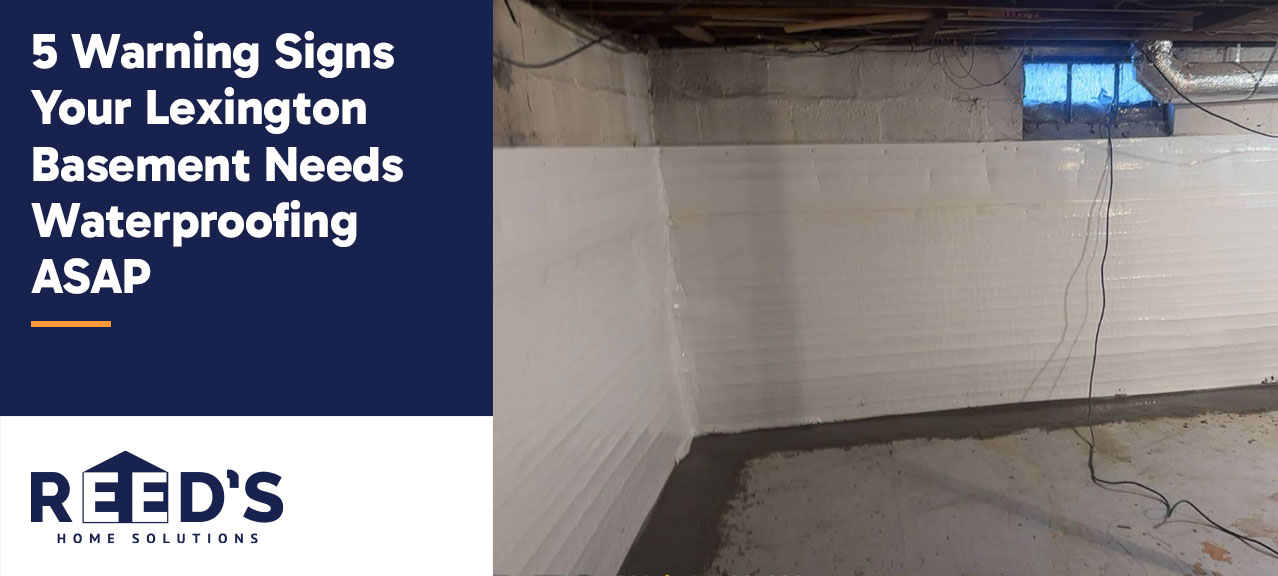
A small basement leak can cost $1,000 and up to fix. Left unaddressed, that same problem escalates to $5,000 to $20,000 or more in major foundation repairs. Mold takes hold within 24 to 48 hours of moisture exposure, and a wet basement severely hurts your property value.
Lexington, KY homeowners face a unique challenge: heavy spring rains paired with expanding clay subsoil create relentless hydrostatic pressure against foundations. In Central Kentucky, basement waterproofing Lexington KY services aren’t just a precaution—they’re an absolute necessity.
Reed’s Home Solutions works with local homeowners every day to catch these problems early. Here are the five critical warning signs your basement is failing—and how acting now protects both your structural integrity and your family’s health.
1. Musty Odors and Persistent High Humidity
That earthy, damp smell in your basement isn’t just unpleasant—it’s one of the clearest wet basement warning signs Lexington homeowners encounter. The moment you notice it, moisture problems are already developing below your living space.
The Cause
The musty odor basement mold Lexington residents recognize comes from microbial volatile organic compounds (MVOCs) released as mold and mildew break down organic materials like wood framing, drywall, and cardboard.
Lexington’s clay soil retains groundwater and builds heavy hydrostatic pressure against foundation walls. During heavy rain, this pressure forces moisture through foundation pores, cracks, and floor joints. Poor ventilation traps that humid air inside.
Key Humidity Benchmark: The EPA recommends keeping indoor relative humidity below 60%. During humid Central Kentucky summers, basement levels routinely spike above 70% to 80% without professional intervention.
The Danger & The “Stack Effect”
Up to 50% of the air in your first-floor living space originates from your basement via the stack effect—warm air rising through your home and pulling basement air upward.
- Health Hazards: The CDC links dampness and mold exposure to respiratory issues, coughing, wheezing, and aggravated asthma or allergy symptoms.
- Structural Degradation: Persistent high humidity quietly rots wood floor joists, corrodes metal fasteners, and ruins wall finishes behind finished drywall.
How to Detect High Humidity
- Condensation: Water droplets forming on basement windows, cold-water pipes, or ductwork.
- Damp Spots: Discoloration or moisture on walls, floors, and surrounding insulation.
- Hygrometer Spike: Consistent relative humidity readings above 60% indicate moisture actively migrating through your concrete.
2. White, Chalky Powder on Masonry Walls (Efflorescence)
When you spot white, powdery deposits spreading across your foundation walls, your basement is leaving behind a visible record of active water movement. This crystalline substance is called efflorescence.
The Cause
Efflorescence forms when water moves through concrete or masonry, dissolving natural minerals inside the material. As that water evaporates into your basement, it leaves dissolved salt deposits behind.
For local homeowners, secondary efflorescence is common—Central Kentucky’s clay soil holds groundwater against foundation walls, creating persistent hydrostatic pressure basement seepage conditions that force water through concrete pores at pressures of 300 to 500 PSI.
The Danger: Spalling and Concrete Failure
Efflorescence itself isn’t toxic, but what it causes beneath the surface is dangerous:
- Osmotic Pressure: As salt builds up, it draws more water toward it, generating internal pressures exceeding 2,000 to 3,000 PSI—far surpassing concrete’s structural limit.
- Spalling: This massive internal force causes the surface concrete to crack, flake, and crumble apart.
- Freeze-Thaw Damage: Winter freeze-thaw cycles expand trapped water within these weakened pores, rapidly accelerating wall breakdown.
Why DIY Paints Fail: Brushing off efflorescence or applying waterproof paint over it traps moisture inside the wall. The migrating water simply forces the paint to bubble, peel, and fail, doing nothing to stop the root cause. Proper basement moisture control Lexington requires stopping water before or as it enters.
3. Water Stains, Flaking Paint, or Peeling Wall Finishes
Painted basement walls should hold their finish for years. When paint starts peeling, bubbling, or blistering, moisture is actively pushing through from the outside.
The Cause
Concrete basement walls are porous. Lexington’s heavy downpours saturate the soil around foundation walls, pushing water inward. Gutters dumping rainwater within 5 to 10 feet of your foundation accelerate this problem.
When moisture vapor pushes through concrete from the exterior, it builds pressure behind impermeable interior latex paint. Trapped water breaks the bond between the paint and concrete, causing peeling, bubbling, and dark brownish water stains along wall bases and corners.
Common High-Risk Locations to Inspect
- Floor-Wall Cove Joints: Where the basement wall meets the floor slab.
- Corners & Base of Walls: Natural collection points for trapped groundwater.
- Below Window Wells: Ground-level windows where pooled rainwater penetrates framing.
- Exterior Downspout Locations: Wall sections directly corresponding to poor exterior downspout drainage.
4. Cracks in Basement Walls or Concrete Floors
Foundation cracks are physical evidence of pressure, settlement, and soil movement working against your home. Cracks serve as open highways for groundwater intrusion.
[ Hydrostatic Lateral Pressure ]
│
▼
┌─────────────────────────────────┐
│ │
│ ============================= │ ◄── Horizontal Crack (Severe)
│ │
│ │ / │ ◄── Vertical / Diagonal Cracks
└────────┴───────────────┴────────┘
Primary Causes in Lexington
- Hydrostatic Soil Expansion: Heavy clay soil swells when wet, exerting immense lateral force against exterior walls.
- Differential Settlement: Uneven soil consolidation causes one part of a home to sink faster than another, cracking rigid concrete.
- Freeze-Thaw Cycles: Water under floor slabs freezes in winter, buckling concrete floors.
Crack Types & Structural Risk Levels
- Horizontal Cracks (Most Severe): Caused by lateral soil pressure pushing walls inward. This indicates imminent wall bowing or structural failure.
- Stair-Step Cracks: Common in cinder block foundations along mortar lines; signals settlement or extreme lateral soil force.
- Vertical/Diagonal Cracks: Often caused by natural settling, but still allow active water seepage and radon gas entry.
- Hairline Floor Cracks: Result from normal concrete shrinkage during curing, but can expand over time.
Red Flag Warning: Seek immediate professional evaluation if any crack exceeds 1/4 inch in width, runs horizontally, shows visible wall displacement, or actively leaks water.
5. Puddles, Standing Water, or Sump Pump Overwork
Standing water on your basement floor is the most urgent warning sign a homeowner can face. It leaves no room for debate—your current drainage or sump pump system has completely failed.
Primary Causes of Flooding
- Exceeded Capacity: Rainwater enters along floor-wall joints faster than the home’s original drainage can handle.
- Sump Pump Failure: Mechanical failure, stuck float switches, clogged intake pits, or burnt-out motors on lower-quality plastic pumps.
- Storm Power Outages: Severe Central Kentucky storms often cut power at the exact moment your sump pump is needed most.
Sump Pump Warning Signs
If your pump exhibits any of these red flags, your basement’s primary defense line is compromised:
- Runs continuously without shutting off.
- Cycles on and off every few minutes during light rain.
- Makes loud grinding, humming, or rattling noises.
- Shows visible rust, or is older than 7 to 10 years.
Why Quick DIY Hacks and Waterproof Paints Fail
Many homeowners attempt to fix moisture issues with over-the-counter waterproof paints or sealers. These DIY approaches fail because they address symptoms rather than the root cause:
| Property | Waterproof Paint / Sealers | Engineered Waterproofing System |
| Pressure Resistance | Holds only ~12 PSI | Handles thousands of lbs of hydrostatic pressure |
| Water Strategy | Blocks moisture on interior surface | Intercepts and redirects groundwater safely away |
| Typical Lifespan | Fails within 6 to 24 months (peels/bubbles) | Permanent, warranted structural protection |
| Mold & Warranty | Fine print excludes mold and efflorescence | Prevents mold growth by controlling humidity |
How Reed’s Home Solutions Fixes Wet Lexington Basements
Reed’s Home Solutions targets water problems at their source using three proven, integrated systems:
1. Interior Perimeter Drainage Systems
We install sub-floor drainage channels along the interior cove joint. These channels collect water migrating through foundation walls or floor seams and direct it safely toward a heavy-duty sump pit—at half the cost of destructive exterior excavation.
2. Heavy-Duty Sump Pump Systems
We install commercial-grade sump pumps equipped with battery backup power. When severe storm events knock out your electricity, our backup systems keep pumping without interruption.
3. Vapor Barriers & Commercial Dehumidification
We line foundation walls with heavy-duty vapor barriers to trap moisture vapor behind the liner and direct it into the perimeter drain. Paired with high-capacity dehumidifiers, we permanently maintain healthy relative humidity levels (40%–50%).
Protect Your Home Before the Next Storm
Basement water problems never fix themselves. Ignoring musty odors, white powder, peeling paint, hairline cracks, or minor puddles allows soil pressure and moisture to cause catastrophic structural damage over time.
Protect your home’s value, structural integrity, and family health with engineered systems built for Central Kentucky’s unique soil profile.
Ready to Fix Your Wet Basement?
Contact Reed’s Home Solutions today to schedule your FREE basement inspection in Lexington, KY. Let our certified specialists deliver the permanent peace of mind your home deserves.