
Your summer KUB bill arrives, and the number is far higher than expected — even though you kept the thermostat at a reasonable setting. For many Knoxville homeowners, this is a familiar and frustrating situation. The real culprit behind those climbing energy costs usually isn’t your HVAC unit’s age or your thermostat habits. It’s the dark, damp crawl space beneath your feet.
Moisture intrusion, unsealed foundation vents, and missing subfloor insulation force your heating and cooling system to work significantly harder than it should. That extra effort shows up directly on your monthly utility bill.
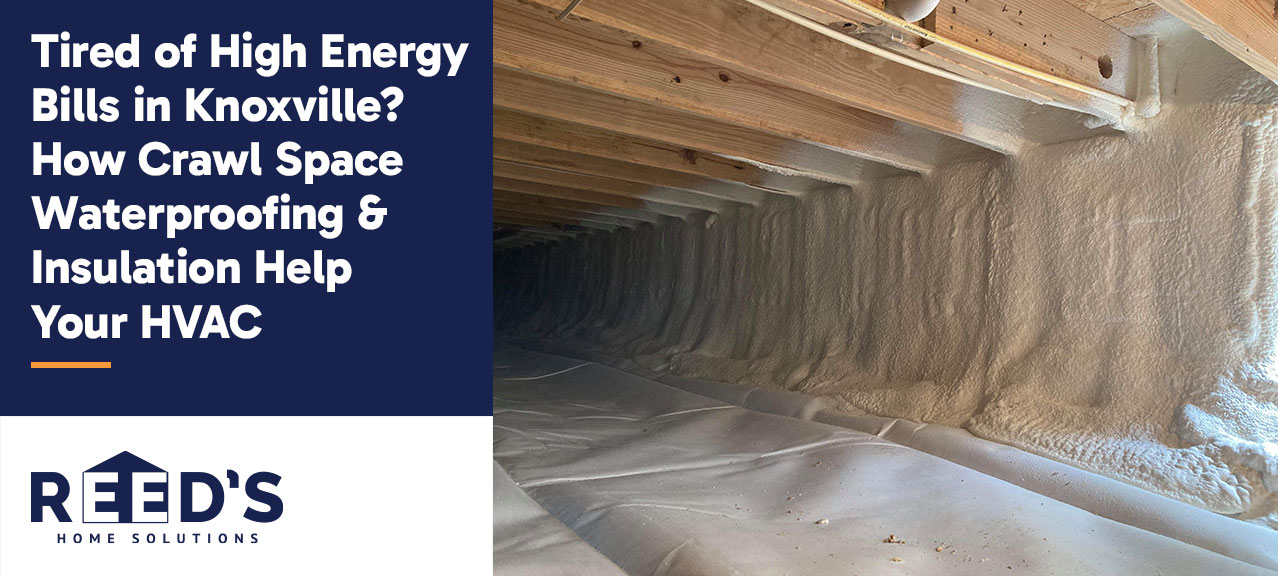
Crawl space waterproofing in Knoxville, TN, combined with proper crawl space insulation, creates a protective thermal envelope that reduces the heating and cooling costs East Tennessee homeowners face year-round. Reed’s Home Solutions specializes in crawl space encapsulation solutions that address the specific challenges Knox County homes experience — helping you lower energy bills while protecting your home from crawl space mold and structural damage.
The Knoxville Climate and the Crawl Space Dilemma
East Tennessee Humidity and Soil Drainage
Knoxville receives 47 to 50 inches of rainfall each year — well above the national average. The clay-heavy soil found across Knox, Anderson, and Blount counties makes things worse. Water doesn’t drain quickly after storms. Instead, the saturated ground pushes moisture against foundation walls through hydrostatic pressure, creating a steady, relentless source of intrusion below your home.
Soil temperatures in this region stay around 55 degrees Fahrenheit year-round, keeping the crawl space environment perpetually cool. When warm, humid summer air enters through foundation vents and contacts those cooler surfaces, condensation forms almost immediately — on ductwork, floor joists, and metal fixtures. That moisture doesn’t just sit there. It creates the conditions your home’s energy efficiency simply cannot survive.
The Stack Effect in Knox County Homes
Your home functions as a vertical air channel. Warm air rises and escapes through attic vents, which creates lower air pressure at ground level. To fill that pressure gap, replacement air gets pulled upward from the lowest available entry point — your crawl space. Research confirms the stack effect pulls 40 to 50 percent of first-floor air directly from the space below.
Every gap around plumbing penetrations, electrical chases, and HVAC boots becomes a pathway for crawl space air into your living areas. During winter months, the temperature difference between 20-degree outdoor air and 70-degree indoor air creates substantial upward pressure, measured at 4 pascals per story of height. The result? You and your family breathe whatever exists in your crawl space every single day — mold spores, excess humidity, and musty odors included.
Why Vented Crawl Spaces Fail in Our Region
Traditional building codes required foundation vents to promote airflow and remove moisture. The logic seemed sound. But in East Tennessee’s humid climate, this design backfires completely.
Measurements consistently show vented crawl spaces maintain humidity above 70 percent, while properly sealed spaces stay below this critical threshold. Advanced Energy’s field studies found sealed crawl spaces averaged 52 percent relative humidity compared to 77 percent in vented spaces. That difference matters enormously — mold growth and wood decay both thrive above 70 percent relative humidity.
During summer, outdoor dew points in Knoxville regularly exceed 65 degrees. When that humid air enters your crawl space and cools against those 55-degree soil temperatures, relative humidity climbs toward saturation. Venting introduces far more moisture than it removes. Sealed crawl spaces, by contrast, reduce energy use by 15 percent versus vented construction, because they stop the constant flow of unconditioned outdoor air that forces your HVAC system to work harder all year long.
How a Damp Crawl Space Forces Your HVAC to Overwork
Moisture and Humidity Mechanics
Humid air behaves very differently than dry air when your HVAC system tries to condition your home. Damp air holds latent heat energy that your equipment must remove before it can actually lower or raise the temperature. When excess moisture from your crawl space raises indoor humidity levels, your body perceives the space as warmer in summer and cooler in winter. You respond by adjusting the thermostat, and your system runs longer cycles just to reach basic comfort. That extra workload strains compressors, blowers, and other critical components over time.
Ductwork Performance Loss in Wet Crawl Spaces
Leaky or poorly sealed ductwork running through a humid crawl space can waste 20 to 30 percent of your HVAC output. When cooled air travels through ducts surrounded by warm, moisture-laden crawl space air, condensation forms on metal surfaces. The results are difficult to reverse:
- Mold growth develops inside and around duct sections
- Duct insulation saturates and collapses away from the metal, allowing conditioned air to escape
- Leaky return ducts pull humid crawl space air directly into your system, circulating contaminated air throughout your home
- Sagging and disconnected duct sections reduce airflow and cooling capacity
Premature Equipment Failure and Constant Cycling
Frequent cycling and extended run times wear down motors and moving parts faster than normal. Your HVAC system experiences increased strain, reduced cooling efficiency, and condensation forming on the equipment itself. Over time, this continuous operation shortens the lifespan of expensive components — potentially pushing replacement costs years ahead of schedule.
The Real Cost to Knoxville Homeowners
A damp crawl space costs you real money every single month. Studies show homeowners can save 15 to 35 percent on energy bills simply by eliminating crawl space humidity. Encapsulated homes use 15 percent less energy compared to vented crawl space homes, with Knoxville-area homeowners reporting monthly savings of $50 to $150 after professional waterproofing. Sealed crawl space construction consistently produces 15 to 30 percent reductions in HVAC-related energy costs. That is not a minor improvement — it adds up to hundreds of dollars every year staying in your pocket rather than going to KUB.
Crawl Space Waterproofing and Encapsulation Solutions
Solving energy waste beneath your home starts with controlling moisture. Reed’s Home Solutions uses proven crawl space waterproofing methods in Knoxville, TN to eliminate water intrusion, block ground vapor, and create a conditioned crawl space environment that supports your HVAC system year-round.
Our waterproofing process includes:
- Interior Drainage Systems: Water management starts below grade. Interior perimeter drainage systems channel groundwater away before it pools on crawl space floors. A perforated corrugated pipe, encased in a silt sock, runs along foundation walls collecting seepage from the footing-wall joint and saturated soil. This pipe directs water to a sump pump installed at the lowest point, which expels moisture through a discharge line terminating far from your foundation. For homes experiencing recurring water intrusion, this drainage infrastructure prevents the standing water that undermines vapor barriers and feeds mold growth.
- Vapor Barrier Installation: Once drainage controls bulk water, a heavy-duty vapor barrier seals the ground permanently. Professional installations use reinforced polyethylene ranging from 6 to 20 mils in thickness, far exceeding basic 6-mil plastic. This durable liner covers the entire crawl space floor, extends up foundation walls, and wraps around support columns. Seams receive specialized tape designed to withstand moisture contact without releasing. The barrier blocks soil gasses, prevents ground moisture evaporation, and creates a clean, dry foundation for your home.
- Crawl Space Vent Sealing: Foundation vents designed for passive airflow actually introduce humidity during East Tennessee summers and cold drafts during winter. Sealing these openings with rigid covers or foam board eliminates outdoor air infiltration that would otherwise compromise moisture control. Paired with a dehumidifier or HVAC supply air, the sealed crawl space holds humidity below damaging levels — turning the space beneath your home into a conditioned zone that reduces heating and cooling costs year-round.
Insulation Methods That Lower Energy Bills in East Tennessee
Moisture control and the right insulation work together. Once you’ve addressed water intrusion, the insulation beneath your home determines how much conditioned air actually stays where it belongs.
Why Old Fiberglass Insulation Fails
Fiberglass batts absorb moisture like a sponge once exposed to crawl space humidity. When wet, the material loses all insulating ability, presses moisture against wooden subfloors, and sags into clumps hanging from floor joists. Relative humidity above 60 percent transforms fiberglass into what contractors call “mold candy” — rapid fungal growth on the organic resin backing takes hold quickly, creating a new problem on top of the original one.
Rigid Foam Board Insulation for Foundation Walls
Rigid foam boards — XPS, EPS, and Polyiso — resist moisture absorption far better than fiberglass. These dense sheets attach directly to foundation walls, creating continuous thermal resistance that stops exterior temperature from transferring into your crawl space. EPS offers better moisture drying capability, while XPS provides tighter moisture resistance. Either option is a significant upgrade over deteriorating fiberglass batts.
Spray Foam on Rim Joists
Uninsulated rim joists account for 15 to 25 percent of total home heat loss. That’s a substantial amount of energy escaping through a relatively small area. Closed-cell spray foam delivers R-7 per inch while simultaneously air-sealing this critical junction — two problems solved in a single application. Professional spray foam insulation runs $2.00 to $4.50 per linear foot.
5 Clear Signs Your Crawl Space Is Driving Up Energy Costs
If you’re unsure whether your crawl space is the problem, your home will tell you. Watch for these warning signs:
- Cold floors during winter mornings
- Unexplained utility bill increases despite consistent thermostat settings
- Musty odors circulating through HVAC vents
- Sagging or deteriorated insulation visible in the crawl space
- Damp, sticky floors even with the air conditioning running
Spotting any one of these issues is reason enough to schedule a crawl space inspection. Spotting several means the problem is already affecting your comfort and your wallet.
Contact Us Today for a Free Crawl Space Inspection in Knoxville
Your crawl space controls more of your home’s comfort and energy costs than most homeowners realize. Moisture intrusion and thermal gaps left unaddressed mean your HVAC system keeps working harder — and your utility bills keep climbing — season after season.
Crawl space waterproofing and proper insulation put a stop to that cycle. Knoxville-area homeowners who address these issues professionally can lower their energy bills by 15 to 35 percent year-round.
Reed’s Home Solutions offers a free crawl space inspection in Knoxville to identify exactly where your heating and cooling dollars are escaping. We will assess the condition of your crawl space and recommend the right solutions for your home and budget — so you can stop overpaying and start protecting your home’s foundation.
Contact us today to schedule your free inspection and take the first step toward a more comfortable, energy-efficient home.