
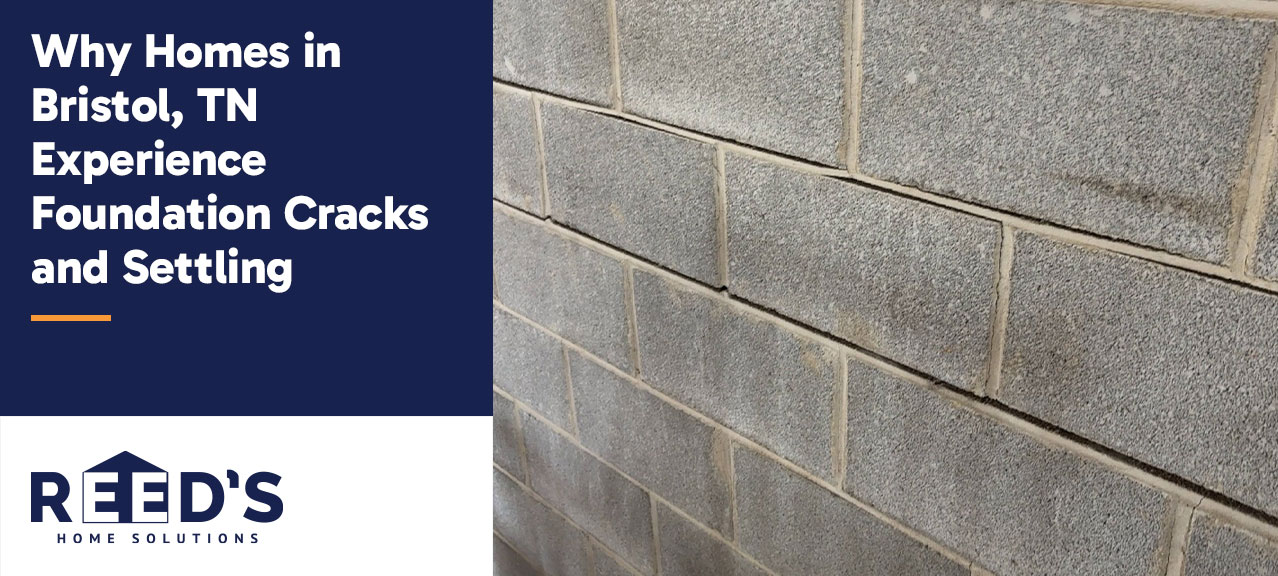
Foundation problems are far more common in Tennessee than many homeowners expect. Clay-heavy soil, frequent rainfall, and seasonal moisture swings create conditions that cause foundations to shift, crack, and settle over time. Bristol homeowners dealing with foundation cracks Bristol Tennessee know the frustration firsthand — basement wall cracks, doors and windows that won’t budge, and sloping floors are all signs that something more serious is happening beneath the home.
At Reed’s Home Solutions, we know the geological challenges that make properties in the Tri-Cities area particularly vulnerable to structural damage. We’ll walk you through the specific causes of foundation cracks and settling in Bristol, point out the warning signs to watch for, and explain how professional foundation repair Bristol TN protects your home’s structural integrity for the long run.
The Bristol Geology Problem: Expansive Clay and Karst Terrain
Bristol sits on some of the most challenging soil conditions in Tennessee. Much of the region rests on clay-rich and silty soil that behaves very differently from stable sandy soil. That difference is exactly what makes foundation cracks Bristol Tennessee such a persistent problem for homeowners here.
Appalachian Clay Soil and the Shrink-Swell Cycle
Clay soil in Sullivan County absorbs massive amounts of water during wet periods and releases it during dry spells. When clay gets saturated, it can expand up to 15% in volume, pushing upward against your foundation in a process called heaving. Laboratory tests on expansive clay show swelling between 8 and 10%, with shrinkage reaching 25 to 30%.
The force behind this movement is staggering. Swelling pressures can reach 1200 kPa — comparable to the weight of a 24-story apartment building. Foundation walls are built to handle loads from above, not sideways pressure. When expanding soil pushes laterally against your walls, they crack, bow, and push inward.
Bristol’s climate makes this worse. Clay contains minerals like montmorillonite that allow water molecules to slip between their layers. Rainy seasons cause the soil to swell; dry spells cause it to shrink. Each cycle — expand, contract, expand again — puts a little more stress on your foundation than the last. The soil shrink-swell cycle East Tennessee experiences is not a one-time event. It’s a continuous, ongoing process.
How Karst Topography Affects Foundation Stability in East Tennessee
Clay soil isn’t the only concern. East Tennessee also sits on limestone bedrock that gradually dissolves over time. The result is what geologists call karst terrain — a landscape characterized by caves, sinkholes, and underground voids. Nearly 60% of Knox County sits on soluble carbonate rock, and that same geological reality extends throughout the Tri-Cities area.
The tricky part about karst is that it hides its problems. A property can look perfectly solid on the surface while a void sits several feet below. When those voids form beneath a home, the soil above eventually drops into them — pulling the foundation down unevenly. Subsurface conditions can shift dramatically within just a few yards across a single development site. There’s no way to know what’s underneath without a proper inspection.
Differential Settlement from Uneven Soil Movement
Differential settlement happens when one section of your foundation moves differently than another. Poor drainage creates localized moisture imbalances around the perimeter of your home. When water pools on one side, that section of clay expands more than the drier areas nearby — and uneven upward pressure is the result.
Trees add to this problem. A mature tree can pull 150 gallons or more of water out of surrounding soil every single day. That creates moisture gradients where soil near the tree contracts significantly more than soil farther away. The stair-step cracks and structural shifts that Reed’s Home Solutions addresses in foundation repair Bristol TN projects are often traced back to exactly this kind of uneven soil movement.
Hydrostatic Pressure and Poor Drainage Around Bristol Foundations
Soil conditions aren’t the only threat to your foundation. Water is equally destructive, and Bristol’s frequent storms and wet seasons make drainage problems a serious concern. When groundwater accumulates around your foundation, it creates hydrostatic pressure against basement and crawl space walls. Saturated soil weighs approximately 60 lbs per cubic foot, which means the lateral force pressing against your foundation walls adds up to thousands of pounds.
How Excess Moisture Creates Lateral Wall Pressure
As water fills the spaces between soil particles, the pressure builds and pushes relentlessly against your foundation. Concrete might appear solid and impermeable, but it’s actually porous. Water finds microscopic air tubes left behind during the curing process and seeps through, creating continuous moisture problems inside your basement.
The damage goes well beyond dampness. Over time, hydrostatic pressure causes foundation walls to bow inward, crack, or buckle. The deeper your foundation sits, the worse the risk becomes — hydrostatic pressure increases with depth below grade. Bowing basement walls in Sullivan County homes most often trace back to exactly this kind of prolonged water exposure.
Common Drainage Problems in Sullivan County Homes
Drainage failures are one of the most preventable causes of foundation damage, yet they’re also among the most overlooked. Here’s what goes wrong in many Sullivan County homes:
- Faulty drainage systems: Systems that are incorrectly installed or deteriorated fail to redirect water away from your foundation properly. Standing water weakens concrete and erodes the surrounding soil, destabilizing your foundation.
- Poor grading: The International Residential Code requires a minimum 6-inch vertical drop for every 10 feet of ground away from the foundation. When the ground slopes toward your home rather than away from it, water flows directly toward your foundation walls.
The Connection Between Roof Runoff and Foundation Damage
What happens at your roofline matters more than most homeowners realize. Downspouts should discharge water at least 5 feet away from your foundation, but many homes direct runoff far closer than that. Clogged gutters make the problem worse — when they overflow during a rainstorm, water dumps directly against foundation walls rather than being channeled away.
This continuous moisture exposure is one of the leading causes of basement cracks Bristol TN homeowners deal with. Reed’s Home Solutions addresses these issues through professional waterproofing and drainage corrections that go after the root cause, not just the symptoms.
Understanding Foundation Cracks: Vertical vs Horizontal Warning Signs
Not all foundation cracks Bristol Tennessee signal the same level of danger. The direction, width, and pattern of a crack reveal whether you’re looking at normal concrete behavior or an active structural problem that needs immediate attention.
Hairline Shrinkage Cracks vs Structural Cracks
Hairline cracks measuring less than 1/16 inch wide are common in concrete foundations. Concrete shrinks as it cures, creating internal tension that the material relieves through cracking. These thin cracks rarely threaten your home’s structural integrity, but they still allow groundwater, radon gas, and moisture vapor into your basement.
Width is a key indicator of severity:
- Cracks narrower than 1/8 inch typically point to minor settling
- Cracks wider than 1/4 inch signal serious structural movement
- Cracks with offset — where one side has shifted relative to the other — indicate active foundation movement that goes beyond simple shrinkage
What Horizontal Cracks Mean for Your Basement Walls
Horizontal cracks are the most serious type of foundation problem. They indicate soil or water pushing your wall inward. FEMA guidelines classify horizontal cracks exceeding 2 inches as major damage, but you shouldn’t wait for cracks to reach that point. Any horizontal crack signals lateral stress that requires immediate professional assessment.
As hydrostatic pressure from saturated soil builds against basement walls — a problem covered in the previous section — walls begin to bow and horizontal cracks appear and worsen over time.
Stair-Step Patterns in Exterior Brick and Block
Stair-step cracks follow mortar joints in brick and concrete block foundations at 30 to 75-degree angles. These are a classic sign of differential settlement, where one section of your foundation sinks faster than another[362]. Cracks wider than 1/4 inch accompanied by wall bulging require professional evaluation right away.
When Diagonal Cracks Signal Foundation Settlement
Diagonal cracks typically run between 30 and 75 degrees[352]. They develop when foundations settle unevenly due to the soil movement and moisture imbalances discussed in earlier sections. A diagonal crack that appears wider at one end than the other confirms uneven foundation movement beneath your home.
5 Red Flags Your Bristol Home Has Foundation Settlement
Knowing what to look for is half the battle when it comes to foundation settling Tri-Cities TN. These five warning signs indicate your Bristol property needs a professional assessment from Reed’s Home Solutions.
- Sticking Doors and Windows: When doors drag across floors, won’t latch properly, or windows become difficult to operate, foundation movement has distorted their frames. You might notice uneven gaps around frames or caulking stretched toward the settling side. If a four-foot level placed on door or window frames shows they’re no longer level, foundation settlement is the likely cause.
- Stair-Step Cracks in Exterior Masonry: Stair-step cracks following mortar joints in brick or block walls signal differential settlement, where foundation sections move independently. These zigzag patterns typically appear near corners or window openings and widen near one end.
- Gaps Between Walls, Ceilings, and Baseboards: Small gaps forming around trim, door frames, or where walls meet ceilings occur because different structural parts move at varying rates. Baseboards separating from walls are another sign of ongoing movement beneath your home.
- Bowing or Leaning Basement Walls: Walls that bulge or curve inward from soil pressure represent serious structural threats that require immediate attention. This is not a problem that improves on its own.
- Slanted Floors and Uneven Surfaces: Floors that feel noticeably sloped, cause furniture to tilt, or leave gaps where baseboards meet flooring point to uneven foundation settling. When one section of your foundation drops lower than the rest, the floor above follows.
If you spot any of these problems in your Bristol home, it’s important to get to the root cause right away. Left unaddressed, foundation issues escalate quickly and lead to far more costly repairs down the road.
Get a Free Inspection from Reed’s Home Solutions
Bristol’s clay soil, drainage issues, and karst terrain aren’t going anywhere — and neither will the foundation problems they cause. Foundation cracks Bristol Tennessee, bowing walls, sticking doors, and sloping floors are all warning signs that get worse when left unaddressed. The sooner you find the source of the problem, the less damage you’ll have to deal with down the road.
Reed’s Home Solutions specializes in foundation repair Bristol TN, and we offer free inspections to assess your home’s structural condition and identify what’s actually causing the problem. Our team understands the unique geological challenges facing the Tri-Cities area and will recommend the right solution for your specific situation.
Contact us today to schedule your free inspection and take the first step toward a more stable, protected home.