
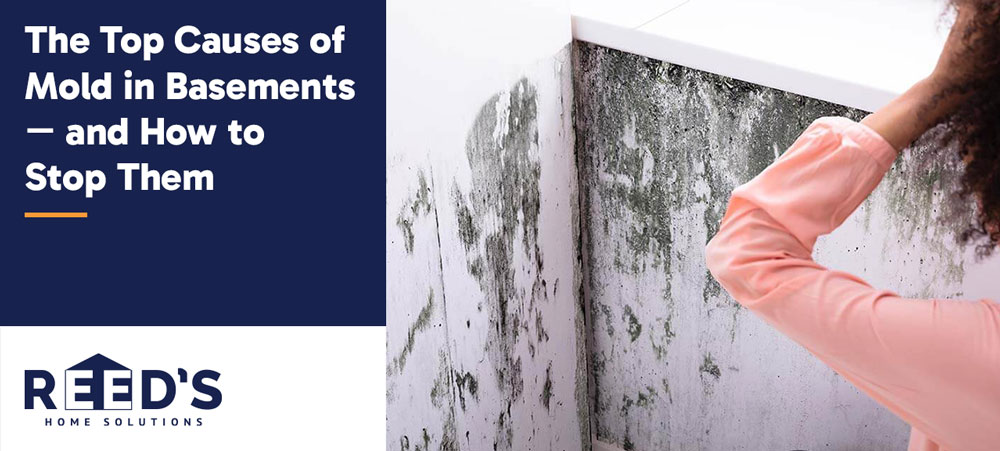
It doesn’t take long for mold in basements to start to form. Mold colonies establish themselves within 24-48 hours when moisture lingers on surfaces. Your basement battles constant moisture challenges, creating ideal conditions for both white and black mold growth.
The problem affects more homes than you might think.
Mold in basement strikes homes throughout Kentucky, West Virginia, Tennessee, and Ohio, where seasonal weather and soil conditions create persistent moisture issues. Whether you’re noticing musty odors, visible growth, or worsening health symptoms at home, understanding root causes helps you take effective action. Success lies in eliminating moisture at its source – once mold establishes itself, it spreads rapidly, affecting your family’s health and your home’s structural integrity.
White Mold vs. Black Mold: What You’re Really Dealing With
Different mold types create distinct problems in your basement. At Reed’s Home Solutions, we regularly encounter both white and black mold across our service areas.
White Mold: The Common Basement Invader
White mold appears as powdery or fluffy growth that homeowners often mistake for dust or mineral deposits. The color ranges from bright white to grayish-cream.
Where white mold loves to grow:
- Concrete walls wicking moisture from surrounding soil
- Wood framing, rim joists, and exposed beams
- Drywall backing and ceiling tiles
- Insulation materials and vapor barriers
White mold feeds on cellulose in wood and paper materials, penetrating deep into porous surfaces.
Black Mold: The Serious Health Threat
Black mold refers specifically to Stachybotrys chartarum, appearing as dark green or black patches with a slimy surface when actively growing.
Black mold requires:
- Continuous moisture for at least 48 hours
- Humidity levels at 70% or higher
- Materials high in cellulose
- Ceiling tiles and fiberboard
- Paper products, including wallpaper
- Wood paneling and insulation backing
How to Tell Them Apart
Texture differences:
- White mold: Fuzzy or powdery appearance
- Black mold: Slimy when wet, grainy when dry
Growth patterns:
- White mold: Spreads as thin dusting or fluffy patches
- Black mold: Forms dense, irregular patches
Surface preferences:
- White mold: Various materials and hard surfaces
- Black mold: High-cellulose materials, penetrating deep
Environmental needs:
- White mold: Cold, damp basement conditions
- Black mold: Warm, humid environments with persistent moisture
Black mold requires professional removal due to mycotoxin production and serious health risks. White mold needs prompt attention and often benefits from professional assessment. For mold growth larger than 10 square feet, or suspected black mold, contact professionals immediately. We identify the specific type, address moisture sources, and safely remove contamination.
What Causes Mold in Basement Spaces?
Knowing the condition of your basement and being preemptive will do wonders in preventing the formation of basement mold. Basements naturally create perfect conditions for mold growth because they face unique moisture challenges.
Humidity Problems and Poor Air Circulation
Your basement should maintain humidity between 30 and 50 percent. When levels climb above 60 percent, moisture alone feeds mold growth. Everyday activities pump moisture into basement air—humidifiers, steam radiators, cooking, and showering create humidity that settles in basement areas.
Basements naturally suffer from poor airflow. Without windows and proper ventilation, moisture accumulates on surfaces. Stagnant air traps moisture around wood framing, cardboard boxes, and fabric storage—exactly what mold needs.
Water Getting Through Foundation Walls
Moisture moves from outside soil into your basement through direct water flow, capillary action, vapor movement, and air leaks.
Capillary action pulls water through concrete pores. Saturated soil creates hydrostatic pressure against walls, widening cracks and letting water seep inside.
Condensation Issues
Warm, humid air creates condensation when it contacts cold basement surfaces. Your concrete walls and floors stay cold from ground contact, causing water to form when warm indoor air meets them.
AC ducts and plumbing lines collect water droplets that drip onto surrounding materials, soaking into drywall, insulation, and wood within 24 to 48 hours.
Drainage System Failures
Poor exterior drainage causes more basement moisture problems than any other factor.
Ground around your foundation must slope away—at least 2 to 3 inches drop every 10 feet. Level or inward-sloping grades direct water straight into your basement.
Gutter problems create concentrated water flow:
- Missing gutters let water pour down walls
- Downspouts without extensions focus water at single points
- Clogged gutters overflow and saturate foundation soil
Window wells work like drains when built incorrectly. Many houses lack proper subsurface drainage. Existing systems fail when pipes collapse or clog.
Plumbing Leaks and Water Damage
Small plumbing leaks create perfect conditions for mold growth behind walls and under floors. Common leak sources include:
- Failed toilet wax seals
- Washing machine hose bursts
- Deteriorated bathroom grout
- Cracked shower pan membranes
If water isn’t dried within 48 hours, mold starts growing.
At Reed’s Home Solutions, we address these moisture sources at their source rather than just treating symptoms.
How Do You Get Rid of Mold in the Basement?
Getting rid of mold in the basement starts with two priorities: protect yourself from spores and eliminate the moisture that allowed the growth in the first place—otherwise it will keep coming back. Before you scrub anything, identify where the water is coming from (leaks, seepage, condensation, or high humidity), isolate the affected area, and decide whether this is a small, surface-level problem you can handle or a larger contamination that needs professional remediation. The steps below walk you through safe cleanup basics, what materials can be cleaned versus removed, and how to dry the space fast enough to prevent regrowth.
Personal Protective Equipment (PPE)
Proper protection prevents mold spore exposure. N95 respirators filter 97% of particles. Seal work areas using plastic sheeting over doors and vents.
The 10 Square Foot Rule
The EPA allows homeowner cleanup for areas under 10 square feet. Larger areas require professional remediation. Call professionals when mold covers more than 10 square feet.
- You suspect black mold (Stachybotrys)
- Growth appears in HVAC systems
- Mold returns after cleanup attempts
Cleaning Hard Surfaces
Clean hard surfaces like tile, glass, and metal with detergent and water. White vinegar or 3% hydrogen peroxide work as alternatives. Apply cleaner, wait 10 to 15 minutes, scrub, wipe, then dry completely.
Avoid bleach—it leaves moisture that feeds remaining mold.
Dealing with Porous Materials
Porous materials like ceiling tiles and carpet often require disposal. Cut out and replace contaminated drywall sections. Remove materials in sealed bags.
Critical Drying Requirements
Dry areas completely within 24 to 48 hours after cleaning to prevent regrowth. Use fans for air circulation and dehumidifiers to maintain 30 to 50 percent humidity. Continue ventilation until materials feel room temperature. Moisture meters verify readings under 15 percent.
At Reed’s Home Solutions, we handle extensive mold problems safely and effectively, protecting your family’s health while solving moisture issues at their source.
Stopping Basement Mold Before It Starts
Prevention stops mold at its source. After dealing with existing growth, address the moisture conditions that allowed it to establish.
Humidity Control: The 30-50% Rule
Maintain basement humidity between 30 and 50 percent. Above 60 percent creates perfect mold conditions. Monitor with a hygrometer and adjust dehumidifier settings when readings exceed 50 percent.
Choose the right dehumidifier:
- Size based on square footage
- Select Energy Star-certified models
- Empty tanks regularly or connect continuous drain
Improve drainage:
- Extend downspouts 6 feet from foundation
- Keep gutters clear and properly pitched
Ventilation: Fresh Air Prevents Stagnant Conditions
Continuous ventilation removes moisture-laden air. Install exhaust fans, inspect HVAC systems routinely, check drain pans regularly, and replace filters frequently.
These prevention strategies create an environment where mold cannot establish itself. Address all four areas—humidity control, structural improvements, drainage, and ventilation—for complete protection.
Recognizing Basement Mold Before It Becomes a Bigger Problem
Your nose often detects mold before your eyes do. That musty smell from your basement serves as an early warning system.
What That Musty Smell Really Means
The characteristic basement mold smell comes from microbial volatile organic compounds (MVOCs) that mold releases as it grows.
Nasal stuffiness, throat irritation, coughing, wheezing, eye irritation, and skin irritation signal potential mold problems. Young children, elderly individuals, and those with compromised immune systems or chronic lung conditions experience serious health risks from mold exposure.
When Professional Testing Makes Sense
Call for professional mold testing when you smell strong mold-like odors without visible growth or experience persistent health symptoms at home.
Reed’s Home Solutions identifies moisture sources and provides solutions addressing mold problems at their root cause.
Professional Mold Solutions for Your Basement
Reed’s Home Solutions specializes in basement waterproofing, moisture control, and mold prevention services throughout Kentucky, West Virginia, Tennessee, and Ohio.
Contact us today.