
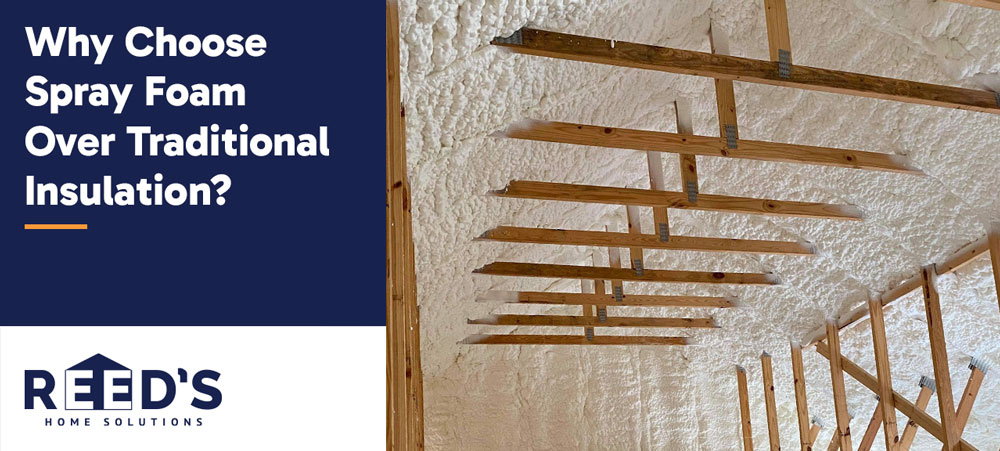
High energy bills, drafty rooms, and uneven temperatures often point to one root issue: poor insulation performance. Many homeowners rely on traditional insulation like fiberglass or cellulose, but these materials typically deliver only 20–30% energy savings compared to what is possible with modern solutions.
At Reed’s Home Solutions, we regularly help homeowners uncover how much energy is being lost through outdated insulation systems. Spray foam insulation can reduce energy costs by up to 50%, making it one of the most effective upgrades available today.
This improvement comes from higher R-value, superior air sealing, and long-term durability. While traditional insulation slows heat transfer, spray foam insulation addresses the bigger problem—air movement.
Understanding how these systems perform helps homeowners make a smarter long-term investment.
Understanding R-Value: What Matters Most
What R-Value Measures
R-value measures thermal resistance, or how well insulation slows heat transfer. Higher R-value means better insulation performance. However, laboratory results do not always reflect real-world conditions.
Factors like moisture, air leakage, and temperature swings reduce the effectiveness of traditional insulation over time. This gap between rated and actual performance is where spray foam insulation stands out—and why Reed’s Home Solutions focuses on solutions that perform in real homes, not just in lab conditions.
R-Value Comparison: Spray Foam vs Traditional Insulation
Here’s how insulation types compare per inch:
- Closed-cell spray foam insulation: R-6.0 to R-7.0
- Open-cell spray foam insulation: R-3.5 to R-4.0
- Cellulose insulation: R-3.2 to R-3.8
- Fiberglass insulation: R-2.2 to R-3.2
Closed cell spray foam delivers significantly more thermal resistance in less space. This makes spray foam insulation especially valuable in tight cavities or areas needing maximum performance.
Traditional insulation may appear cost-effective initially, but its lower R-value requires more thickness to achieve the same results—something we frequently point out during Reed’s Home Solutions free insulation assessments.
How Traditional Insulation Loses Performance
Traditional insulation degrades over time in several ways:
- Fiberglass can lose up to 50% of its R-value when compressed
- Loose-fill insulation settles, reducing coverage
- Moisture lowers thermal performance
- Air movement disrupts insulation effectiveness
Research shows fiberglass can lose 35–50% effectiveness in cold conditions due to convection loops. These issues reduce energy efficiency and increase utility costs.
In contrast, spray foam insulation maintains stable performance because it resists air movement, moisture, and compression—one of the key reasons Reed’s Home Solutions recommends it for long-term performance.
Air Sealing: The Biggest Performance Gap
Why Traditional Insulation Falls Short
Air leakage accounts for up to 35% of heat loss in homes. Traditional insulation does not stop this.
Fiberglass and cellulose are porous materials. Air passes through or around them, carrying heat and moisture. Even well-installed traditional insulation leaves gaps at seams, joints, and penetrations.
Additional air sealing is required, but it rarely achieves complete coverage.
How Spray Foam Insulation Stops Air Leakage
Spray foam insulation expands upon application, filling cracks and bonding to surfaces. This creates a continuous air barrier.
Air sealing performance depends on thickness:
- Closed cell spray foam: effective at 1–1.5 inches
- Open-cell spray foam: effective at 3.5–5.5 inches
Studies show spray foam insulation reduces air leakage by 40–50% compared to traditional insulation methods.
This combination of insulation and air sealing is why Reed’s Home Solutions installs spray foam insulation as a complete system—not just a material upgrade.
Eliminating Drafts and Uneven Temperatures
Problem areas like rim joists, attics, and crawl spaces commonly allow air leakage.
Spray foam insulation expands into these irregular spaces, sealing areas where traditional insulation cannot. Homeowners report a major reduction in drafts and more consistent indoor temperatures.
Without air leaks, HVAC systems operate more efficiently, improving comfort and energy efficiency throughout the home—results we consistently see with Reed’s Home Solutions insulation projects.
Moisture Control: A Critical Advantage
Problems with Traditional Insulation
Moisture is one of the biggest threats to insulation performance.
Fiberglass traps moisture rather than stopping it. Even small increases in moisture content can reduce R-value by up to 50%. Damp insulation creates conditions for mold growth on nearby wood.
Cellulose absorbs and releases moisture, but over time, this can weaken its mold resistance.
These issues are especially common in crawl spaces, basements, and attics.
Spray Foam Insulation Prevents Moisture Issues
Closed cell spray foam acts as both insulation and a moisture barrier.
At 1.5–2 inches thickness, it functions as a vapor retarder. It prevents moisture from entering wall cavities, reducing the risk of mold, rot, and damage.
Spray foam insulation does not absorb water and does not provide a food source for mold or pests. This creates a healthier indoor environment and protects structural components—another reason Reed’s Home Solutions frequently recommends closed cell spray foam for crawl spaces and basements.
Added Structural Strength
Unlike traditional insulation, closed cell spray foam adds structural support.
Testing shows walls insulated with spray foam insulation can have up to 300% greater strength. This reinforcement helps resist shifting, warping, and long-term structural wear.
Real Cost Comparison
Upfront Costs
- Traditional insulation: $0.30–$1.80 per square foot
- Open-cell spray foam insulation: $0.50–$1.50 per square foot
- Closed cell spray foam insulation: $1.50–$4.50 per square foot
While spray foam insulation has a higher upfront cost, it provides greater long-term value through performance and durability.
Energy Savings & ROI
Spray foam insulation can reduce energy bills by 30–50%.
For a homeowner spending $300 per month on utilities, a 40% reduction equals:
- $1,440 saved annually
- $14,400 saved over 10 years
Most homeowners recover the cost of spray foam insulation within 3–5 years. After that, savings continue for decades.
At Reed’s Home Solutions, we help homeowners evaluate real ROI through free estimates and energy-saving projections tailored to their property.
Energy efficiency improvements can also increase home value by up to 6%.
Long-Term Performance vs Traditional Insulation
Traditional insulation often requires replacement or upgrades due to:
- Settling
- Moisture damage
- Reduced effectiveness
Spray foam insulation lasts over 30 years with minimal degradation. It maintains consistent energy efficiency without additional maintenance.
Open Cell vs Closed Cell Spray Foam
Both types of spray foam insulation offer advantages:
Open-cell spray foam
- Lower cost
- Good for interior walls
- Effective for air sealing
Closed cell spray foam
- Higher R-value
- Acts as a moisture barrier
- Adds structural strength
Closed cell spray foam is ideal for crawl spaces, basements, and areas prone to moisture—applications where Reed’s Home Solutions specializes in long-term performance solutions. Interested in crawl space insulation? Give us a call!
Making the Right Choice for Your Home
Spray foam insulation provides clear advantages over traditional insulation:
- Higher R-value
- Superior air sealing
- Improved moisture control
- Long-term durability
- Lower energy costs
Traditional insulation may have a lower upfront price, but it cannot match the overall performance of spray foam insulation.
For homeowners focused on energy efficiency, comfort, and long-term value, spray foam insulation is the stronger investment—and Reed’s Home Solutions is here to guide that decision with expert recommendations and professional installation.
Final Takeaway
If your home struggles with drafts, uneven temperatures, or high energy bills, insulation performance is likely the issue.
Spray foam insulation solves multiple problems at once by improving thermal resistance, stopping air leakage, and preventing moisture damage.
With energy savings of up to 50% and a lifespan exceeding 30 years, spray foam insulation delivers value that traditional insulation simply cannot match.
Schedule a free inspection with Reed’s Home Solutions to see how upgraded insulation can improve your comfort, efficiency, and long-term savings.