
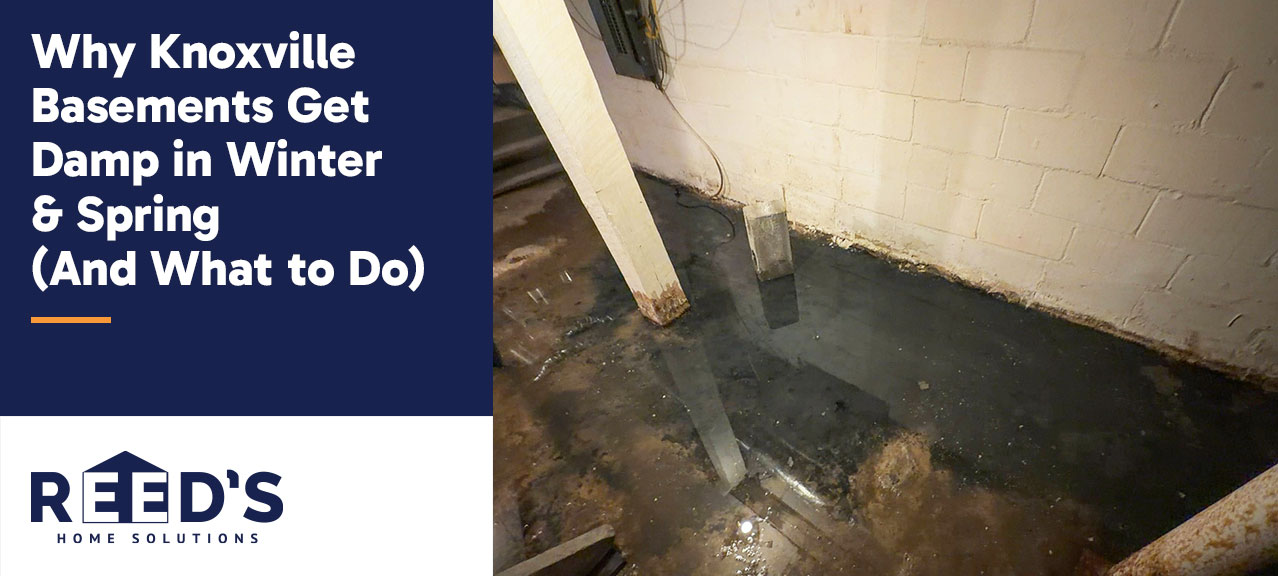
A damp Knoxville basement is more than just an inconvenience — it can increase your heating bills by 10-15%, and that’s before you factor in the mold, structural damage, and foundation problems that follow. Cold weather and shifting groundwater levels work against your home’s foundation year-round, creating moisture problems that get worse the longer they go unaddressed.
Basement moisture in Knoxville, TN doesn’t come from a single source. Winter dampness and spring dampness in Knoxville are two completely different problems. Winter moisture is mostly a condensation issue — warm indoor air drifts down and hits cold basement surfaces. Spring moisture is an entirely different story, driven by groundwater rise and heavy runoff. To put it in perspective, one inch of rain falling on a 2,000 sq. ft. roof produces 1,250 gallons of water — water that can push directly against your foundation.
Each season creates its own set of challenges, and each one calls for a different solution. Reed’s Home Solutions will break down exactly what’s happening in your basement and what actually works to fix it.
What Causes Basement Dampness in Winter vs. Spring
Winter and spring basement dampness in Knoxville come from opposite directions — and treating one problem the same way you’d treat the other is where most homeowners go wrong.
Winter is a condensation problem. Cold air holds very little moisture, so basement humidity often drops below 30 percent. The real issue starts when your heating system warms the air inside your home. That warm, moist air drifts downward into the basement and hits cold walls and floors. Moisture then moves into your basement through four pathways: liquid water flow, capillary suction, vapor diffusion, and air movement. The stack effect makes things worse — warm air rising through your home creates negative pressure that pulls cold, damp air in through foundation cracks and soil contact.
Spring works completely differently. Snowmelt and heavy rain saturate the soil surrounding your foundation, and hydrostatic pressure forces water through any crack or weak point it can find. Basement humidity during this period rarely drops below 60 percent. Frozen ground thaws all at once, releasing months of accumulated moisture that moves straight toward your foundation. On top of the seepage, warm humid outdoor air finds its way into your cooler basement space, adding a condensation layer to an already serious problem.
Same symptom — a damp basement — but two completely different causes. Knowing which one you’re dealing with is the first step toward fixing it.
Why Knoxville’s Climate Creates Two Different Basement Moisture Seasons
Knoxville sits in East Tennessee, and that location matters when it comes to your basement. The region gets roughly 48 to 50 inches of rain annually — well above the national average — while humidity hovers near 70 percent year-round. Add East Tennessee’s clay-heavy soil into the picture, and the problem compounds further. Clay expands when it absorbs water and shrinks when it dries out, putting repeated stress on foundation walls through every wet and dry cycle.
Winter Basement Dampness: Causes and Signs
Winter temperatures in Knoxville frequently swing around the freezing mark, and those fluctuations trigger freeze-thaw cycles that are hard on basement structures. Water trapped in the soil freezes and expands by roughly 9 percent, pressing directly against your foundation walls. When temperatures climb back above freezing, that ice melts and water finds its way into any cracks that have formed. Frozen ground also pushes moisture toward your foundation through hydrostatic pressure, forcing vapors through porous concrete and driving humidity levels up.
Watch for these warning signs during winter months:
- Water droplets forming on basement walls or windows
- Damp concrete floors, especially near the base of walls
- Musty air that worsens when your heating system runs
Spring Basement Dampness: Causes and Signs
Spring and early summer bring heavier, more intense rainfall that drainage systems often struggle to keep up with. Saturated soil creates hydrostatic pressure that forces water through any crack or weak point in your foundation. Knoxville’s rolling terrain makes this worse for homes sitting in valleys, where runoff from surrounding areas concentrates directly around your foundation.
Look for these warning signs as the season shifts:
- Pooled water along baseboards after storms
- Staining on walls that appears following heavy rain
- White powdery efflorescence forming on foundation walls
- Musty odors that return or linger after rainfall
If you’re spotting any of these signs, it’s important to identify the source quickly. Left unaddressed, seasonal moisture problems escalate into foundation damage, mold growth, and costly structural repairs.
Winter vs. Spring Basement Moisture: Side-by-Side Comparison
Basement humidity readings shift dramatically between seasons in Knoxville. Winter humidity typically falls between 25-45% RH with low mold risk, while spring levels climb to 50-65% RH with moderate risk. Summer pushes readings to 65-85%+ RH — the threshold where mold can colonize within 24-48 hours.
Winter humidity dropping below 25% brings static electricity and respiratory issues. Readings above 50% during cold months put your basement at high risk for condensation on cold surfaces. Spring creates the opposite problem — readings won’t drop below 60% during heavy thaw periods, and saturated soil keeps pushing moisture against your foundation walls until the ground dries out.
Why Ignoring Seasonal Dampness Leads to Bigger Problems
Putting off basement moisture problems doesn’t make them smaller — it makes them worse. Mold colonizes within 24-48 hours of water exposure, and once it takes hold, spores spread throughout your home quickly. Long-term exposure to mold in Knoxville leads to chronic respiratory issues, allergy flare-ups, and asthma attacks. Wood framing soaks up ambient moisture over time, developing rot that compromises the structural integrity of your home. Foundation damage follows close behind, as water leaches minerals from concrete and creates efflorescence and hairline cracks that expand with every freeze-thaw cycle.
There’s a financial cost, too. Moist air takes more thermal energy to heat than dry air, which drives up your energy bills. Homes with known moisture problems can see sale prices drop by up to 10%, and buyers frequently walk away altogether when inspections turn up water damage.
The good news is that both winter and spring dampness are fixable — if you know what you’re dealing with.
What to Do About Winter Basement Dampness
- Monitor basement humidity and keep it between 25-40% using a hygrometer
- Insulate cold water pipes and rim joists where condensation tends to form
- Seal air leaks with caulk or spray foam to stop cold air from entering through cracks
- Clear snow 3-5 feet away from your foundation to prevent saturation as it melts
- Check that sump discharge pipes aren’t buried in snow or frozen solid
What to Do About Spring Basement Dampness
- Extend downspouts 5-10 feet away from the foundation to redirect runoff
- Install interior French drains to capture hydrostatic pressure before water reaches your floors
- Sump pump installation provides a critical last line of defense during heavy thaw periods
- Epoxy injection permanently seals foundation cracks that are letting in snowmelt
If you spot any of these problems, it’s important to find the source and get it taken care of right away. The longer moisture sits, the more damage it does — and the more it costs to fix.
Do You Need Waterproofing or Just Humidity Control?
Knowing which solution your basement actually needs starts with understanding what each one does. A dehumidifier removes water vapor from the air, but it cannot stop liquid water from entering your basement. Waterproofing addresses liquid water intrusion at the source, while dehumidification manages airborne moisture after the fact. Some Knoxville homes need only humidity control. Others require waterproofing first, followed by a dehumidifier to maintain dry, comfortable conditions year-round.
There are clear signs that point to professional waterproofing over a simple dehumidifier purchase. If your humidity stays above 60% even with a dehumidifier running continuously, a dehumidifier alone is not enough. Other warning signs include:
- Water seeping through wall or floor cracks
- Mold that keeps coming back despite repeated cleaning
- Musty odors that linger no matter how much you ventilate
- Condensation forming constantly on basement surfaces
The EPA recommends keeping indoor relative humidity between 30% and 60% to prevent mold growth. If you cannot hold those levels, liquid water is likely the culprit.
A dehumidifier treats the symptom. Waterproofing fixes the root problem. That said, even after waterproofing, below-grade spaces stay cooler than the rest of your home, and moisture vapor can still enter through surrounding concrete. The two solutions are not competing options. They serve different purposes and work best together. Waterproofing controls where liquid water goes. Dehumidification keeps your indoor conditions where they need to be once that protection is in place.
At Reed’s Home Solutions, we evaluate foundation cracks, water staining, efflorescence, and drainage conditions before recommending anything. Purchasing equipment before identifying the actual moisture source leads to wasted money and ongoing frustration.
How Reed’s Home Solutions Diagnoses Basement Moisture in Knoxville
Most homeowners spend thousands treating the wrong problem. Water on your basement wall doesn’t reveal whether it condensed from indoor air or seeped through from outside, and that distinction determines everything about the right fix.
Reed’s Home Solutions starts every Knoxville assessment with a careful visual inspection. Your walls tell a story on their own. Horizontal tide marks at consistent heights point to recurring water intrusion at that level. Efflorescence concentrated at specific cracks indicates active seepage, while widespread white deposits across wall faces suggest capillary wicking through porous concrete. Stair-step cracking through mortar joints signals settlement or soil pressure — structural issues that need attention before any waterproofing work begins.
After visual inspection, we use the plastic sheet test. Tape a 12×12-inch piece of plastic against damp wall sections, seal all edges, and wait 24-48 hours. Moisture collecting on the room-facing side confirms condensation. Water behind the plastic means seepage or wicking from exterior sources.
From there, we use moisture meters and hygrometers to complete the picture:
- Pin-type moisture meters measure electrical resistance in wood joists and framing. Readings above 20% moisture content indicate high mold risk requiring immediate remediation.
- Pinless meters scan large wall areas without penetration, mapping wet zones behind finished drywall.
- Hygrometers track basement humidity levels. Readings above 60% point to water intrusion rather than simple condensation.
This systematic approach identifies your actual problem before any solution is recommended. If you have a damp basement in Knoxville, contact Reed’s Home Solutions today for a free inspection and find out exactly what’s happening — and what it takes to fix it for good.